

Labeling for Batch Codes and Compliance: Lot Coding, Traceability, and FSMA 204 (2026)
One wrong date, a smudged code, or a missing lot number can turn a routine shipment into a recall, a retailer chargeback, or an FDA headache. That’s why labeling for batch coding and compliance can’t live in a spreadsheet and a hope.
A batch code (lot code) is a short identifier printed on the package that ties a specific run of product to its ingredients, packaging, and production records. When an issue pops up, that code is what lets you trace affected units fast, limit the scope of a recall, and show customers (and buyers) you’re in control. Just as important, clean, consistent coding protects your brand when products move through distributors, co-packers, and multiple warehouses.
Teams feel this across the business. Operations and QA need readable, verifiable codes on every unit and case, supply chain needs records that match what shipped, and marketing needs packaging that stays on brand without risking compliance.
FSMA Rule 204 was slated to begin January 20, 2026, and the FDA has since extended the compliance date to July 20, 2028. Even with extra time, now’s the moment to tighten your process, because fixing coding and traceability under pressure costs more and hurts trust.
What batch codes actually do (and how they fit into modern labeling)
A batch code (also called a lot code) is the “breadcrumb trail” that connects one package to a specific production run. It doesn’t tell the shopper everything, it tells your team where to look. When a customer reports an off taste in a beverage, a broken seal on an OTC product, or a smell change in a cosmetic, the batch code points you to the exact records behind that unit.

In modern labeling, the code is only useful if it links to records you can pull fast, whether that’s in an ERP, a shared drive, or well-kept paper batch sheets. In practice, a batch code usually points back to details like a production date or time window, the facility and line, ingredient or component lots, shift, and even recipe or formula version.
Batch code vs. expiration date vs. barcode, stop mixing these up
These marks can sit inches apart, but they do very different jobs.
- Batch (lot) code: Identifies a production group. It’s the key that lets QA trace what went into the product and how it was made.
- Expiration date or best by: Communicates freshness and safety timing to the consumer. It helps people know when quality may drop, or when the product should not be used.
- Barcode (UPC/GTIN, and increasingly 2D codes): Supports checkout and inventory. When you move to 2D, it can also carry more traceability data (like a lot and date) for faster scanning through the supply chain.
A quick way to keep it straight: the date is for the shopper, the batch code is for your investigation, the barcode is for the register and the warehouse.
Here’s a simple example using a snack pouch or supplement bottle:
- What a consumer sees: “Best by 10/2027” and a UPC that scans at checkout.
- What QA needs: “Lot L24093B” (or similar), which ties back to batch records, ingredient lots, sanitation checks, and hold or release notes.
Also, don’t confuse a batch code with a serial number. Serial numbers identify one unique unit (common in medical devices, electronics, or some high-value goods). Batch codes identify a group of units made together (common in food, beverages, supplements, OTC, and cosmetics).
Where codes should go on packaging so people and scanners can actually read them
If you want labeling that holds up in the real world, placement matters as much as the code format. Pick a consistent location, then stick to it across every SKU and every run. That way, warehouse teams don’t hunt for it, and buyers or auditors see control, not chaos.
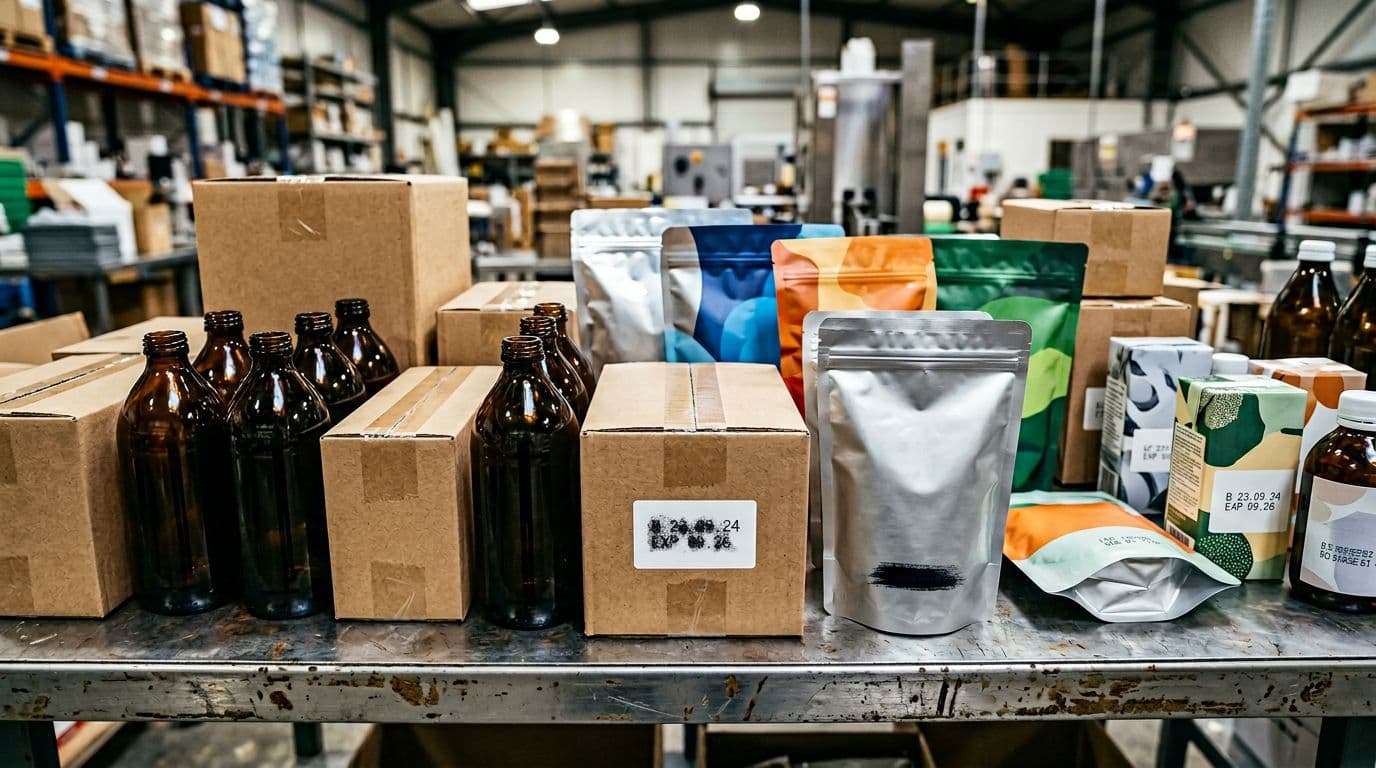
A few practical placement rules that prevent headaches:
- Avoid seams, folds, and crinkle zones (common on pouches and shrink sleeves).
- Stay away from high-gloss glare spots and heavily varnished areas.
- Keep the code off busy artwork that kills contrast.
- Give it breathing room, so it isn’t wrapped around a curve or tucked under a cap ridge.
Common printing methods you’ll see on lines include inkjet (fast and flexible), laser (durable on certain materials), and thermal transfer (common for labels and cartons). Typical packaging targets include bottle bases or caps, carton bottoms or side panels, and pouch back panels near a flat seal area.
Before a full run, test like a skeptic:
- Legibility test: Can you read it quickly from arm’s length under normal warehouse lighting?
- Rub and smear test: Does it survive handling, condensation (beverages), and scuffs in cases?
- Scanner test: If you use 1D or 2D, does it scan on the line and in the warehouse?
- Location test: Does the code stay visible after case packing, tray packing, or shrink wrapping?
What “traceability” really means in day-to-day operations
Traceability isn’t a buzzword, it’s the daily habit of connecting dots. It starts when you receive ingredients and packaging components, then continues through production, warehousing, and shipping. Every handoff should keep the batch identity intact, from ingredient lots to finished cases to pallet labels.

Here’s how it looks on a normal week:
- Receiving: You log ingredient lots (for example, flavor, vitamin premix, or fragrance oil) and packaging lots (bottles, caps, labels).
- Production: You assign a batch code to the run, then record what lots went in, what line ran it, who was on shift, and what checks passed.
- Warehousing: You store and pick by code and date, which supports FIFO (first in, first out). That reduces expired products and surprise write-offs.
- Shipping: You record which lots went to which customers, so you can answer questions fast.
When something goes wrong, batch codes turn a messy search into a targeted response. Instead of pulling everything, you isolate the affected run, check the linked records, and narrow the scope.
A code printed on a pack is only half the system. The other half is being able to pull the matching record set quickly during an audit or recall.
The payoff is real: smaller recalls, fewer chargebacks, fewer expired units, and cleaner root cause work when quality issues hit food, beverages, supplements, OTC, or cosmetics.
The compliance basics brands cannot ignore in 2026
Compliance is not just about what’s printed on the pack. It’s about what you can prove later, fast, and without guesswork: what you made, when you made it, where it went, and which products share the same risk.
Labeling sits at the center of that proof. A clean lot code that matches your records is like a key that opens the right file drawer every time. Still, requirements vary by product type and selling channel, so confirm the details with your QA or regulatory team before you print.
US spotlight: FSMA Food Traceability Rule (Rule 204) and what changes on January 20, 2026

FSMA Rule 204 matters if you manufacture, process, pack, or hold foods on the Food Traceability List (FTL). In plain terms, if you handle certain higher risk foods (for example, many fresh items and ready-to-eat foods on the list), you may need tighter tracking across each handoff in your supply chain.
A core idea is the traceability lot code (TLC). Think of it as the supply chain’s shared “case file number” for a specific lot of food. The TLC is what links the physical product to the records that explain its story.
Those records are built from Key Data Elements (KDEs) captured at Critical Tracking Events (CTEs). You do not need to memorize the acronyms, but you do need the outcomes:
- Your lot code strategy must stay consistent from incoming ingredients to finished cases and shipments.
- Your system must store the basics that answer: what product, which lot, how much, from who, to who, where, and when.
- When FDA asks, you’re expected to provide requested traceability records within 24 hours.
The big date to watch was January 20, 2026. However, FDA has extended the compliance date to July 20, 2028. Some teams still discuss extensions and phased timelines, so keep an eye on updates. Even so, building for 2026 is smart because retailers and distributors often push faster than regulators.
Practically, get these labeling and recordkeeping pieces ready now:
- Unit and case coding rules: Decide where the TLC or lot code appears (unit, case, pallet label), and keep placement consistent.
- Readable print under real handling: Condensation, scuffs, shrink wrap, and freezer conditions can ruin ink. Validate durability early.
- One source of truth for lot assignment: Prevent “same day, two codes” errors across plants or co-packers.
- 24-hour retrieval drill: Run a mock request. Can you pull receiving, production, and shipping records fast, and do they agree?
If your records cannot match your printed lot codes quickly, your labeling is decoration, not compliance.
If you rely on a co-packer, lock down who assigns lot codes, who prints them, and who stores the records. This is a common gap when brands outsource packing (see https://msl-indy.com/when-to-use-a-co-packer/).
Labeling details regulators and retailers look for first
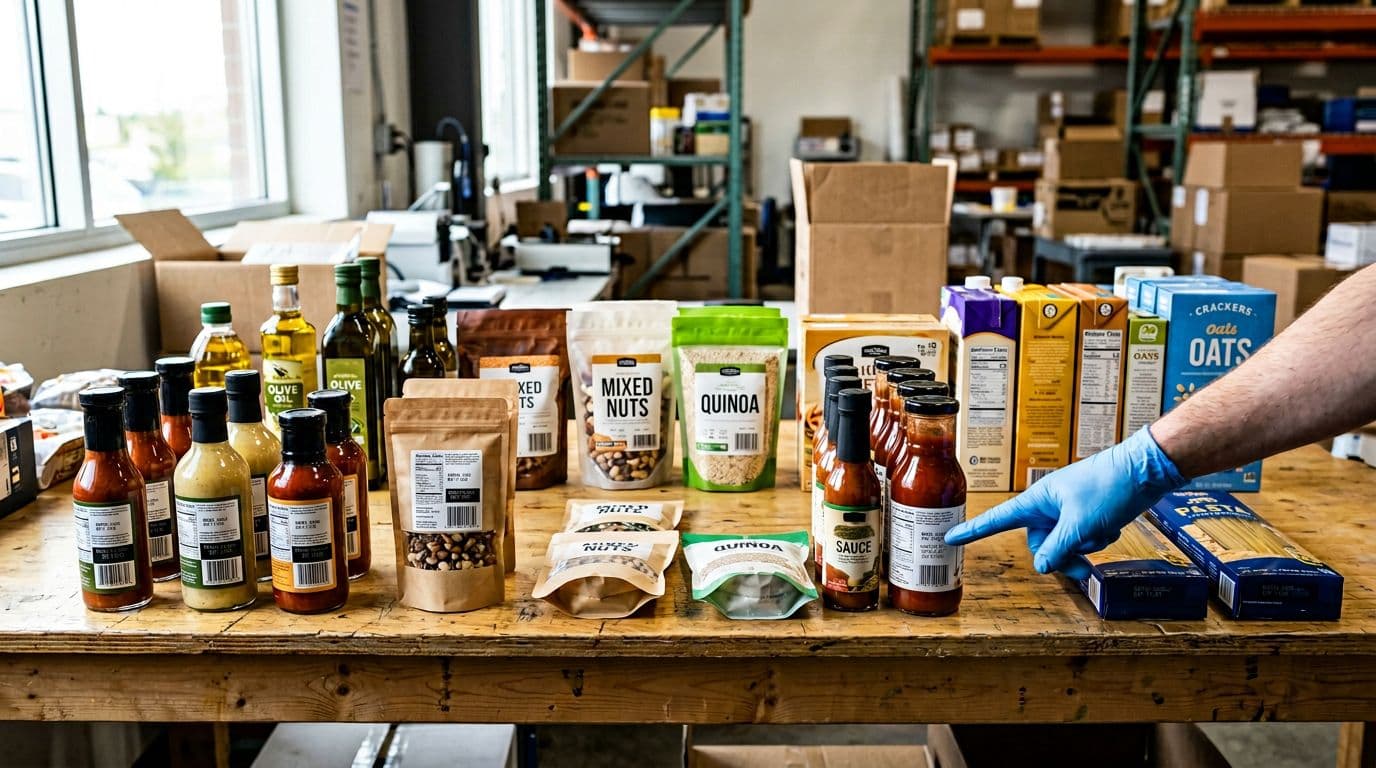
Most audits and retailer inspections start with fast, obvious checks. These are the common labeling issues that trigger holds, rework, and chargebacks.
Start with the big one: missing or inconsistent lot codes. A code on the unit, but not the case, causes traceability breaks. Two different formats across SKUs slows down receiving and recall response.
Next, watch these “first look” problems:
- Wrong date format or mixed date styles: If some SKUs use
MM/DD/YYand others useDD/MM/YY, you invite confusion. Pick a standard and document it. - Unreadable print: Smears, low contrast, dot-matrix fade, or codes printed over seams often fail at the dock.
- Incorrect ingredients or allergen statements: One outdated allergen callout can create a serious safety issue, not just a compliance one.
- Net quantity errors: Make sure the declared net contents matches the correct unit and placement rules for your category.
- Missing manufacturer, packer, or distributor info: Retailer teams check “who is responsible” quickly.
- Country of origin and “Made in USA” claims (when used): Claims must match the product and substantiation rules, and they get scrutiny because shoppers notice them.
Dietary supplements add another layer. At a high level, regulators and retailers expect a compliant Supplement Facts panel, a clear product identity statement, and responsible party contact info. Batch codes often show up on the bottle base, the label edge, the carton bottom, or the neck band. The same rule applies: your code must stay readable and tie back to your batch record.
Selling across borders: plan for the strictest rule in your target markets
Selling in more than one region turns labeling into version management. The safest approach is to build a core label that meets the toughest common requirements, then add market-specific overlays (language, nutrition format, local addresses, symbols, and claim restrictions).
Many global food rules, including EU food information requirements, expect lot identification and date marking, but the details vary. Even simple choices like date order, required phrases, and where the lot appears can change by market and retailer.
To keep control, set up two habits that prevent expensive reprints:
- Maintain a market requirements matrix: One table, owned by QA or regulatory, that lists what must appear for each country, channel, and product type.
- Use strict version control for artwork: Old files love to resurface during a rush order. Lock approvals, archive final PDFs, and tie label versions to specific lots in your records.
When you plan this way, labeling stops being a scramble. It becomes a controlled system that supports traceability, retailer compliance, and faster issue response.
A simple, repeatable system for getting labeling right every time
Good labeling does not come from heroics on the floor. It comes from a simple system that your team can run the same way on Monday morning and during a Friday rush order. The goal is straightforward: every unit gets the right code, it prints cleanly, it gets verified, and your records match what shipped.
This playbook works for small and mid-size brands because it ties together people (clear owners), process (documented rules), and equipment (verification that never gets tired). Once it is in place, co-packers and extra plants stop feeling like a risk, and start feeling like capacity.
Start with a label master file and a clear code format standard

First, create one place where the truth lives. Call it your label master file (LMF). It can be a controlled folder in your QMS, a PLM system, or a tightly permissioned drive. What matters is that everyone pulls the same approved files, every time.
Your LMF should include, at minimum:
- Approved label artwork: Final PDFs, version numbers, and the date they were approved.
- Approved code format(s): Exactly what the lot code looks like, including any prefixes, plant identifiers, and separators.
- Date rules: The format (for example,
YYYYMMDD), time zone, and the logic behind it (production date vs. pack date). - Variable field map: Where each variable prints (unit, case, pallet label), and the exact location on pack (panel, edge, bottom).
- Print method notes: Inkjet vs. laser vs. thermal transfer, plus the best material settings you validated.
Keep the code format standard boring on purpose. Boring is readable, trainable, and auditable. A simple example: PL1-20260301-B03 (Plant 1, date, batch sequence). The point is not the exact syntax, it is that every team uses the same rules.
Next, decide how codes get generated. Bigger operations use ERP or MES logic so lot assignment is automated and logged. Smaller brands can still run tight control with a locked template spreadsheet that generates codes (with protected cells, an approval step, and an export log). Either way, assign owners:
- Who creates the code rule (often QA).
- Who assigns the lot (often production or scheduling).
- Who approves changes (QA plus operations).
- Who updates co-packers and plants (one named role, not “whoever remembers”).
Consistency across co-packers and plants comes from one habit: you send them the same “labeling packet” every time. Include the artwork version, code format, placement photo, and a sign-off sheet. If you are outsourcing packaging, align early on the model choice and roles, so you do not split responsibility by accident (see https://msl-indy.com/co-packing-vs-private-label/).
Finally, treat records like you will need them under pressure. Besides the regulatory minimums, a common best practice is to keep traceability records for shelf life plus one year, so you can still prove what happened if a complaint comes in late.
If you cannot point to one approved file set and one code rule, every line change becomes a new chance to get it wrong.
Build “print, verify, reject” into the line so errors do not ship

A repeatable labeling system needs a hard stop for bad prints. That is where “print, verify, reject” comes in. The printer applies the lot code and date, then an inline scanner or vision system checks it in real time, and the line automatically rejects any unit that does not pass.
In plain terms, the verification system answers two questions:
- Can it be read? (contrast, clarity, and damage)
- Is it correct? (right SKU, right format, right date or lot)
When something fails, the reject device removes the bad unit from the flow, so it cannot sneak into a case. That matters because manual spot checks alone break down on fast lines. People get distracted, the sample size is small, and the worst prints often happen in bursts (a wet label roll, a clogged nozzle, a cold bottle sweating on contact). Automation catches the bursts.
To make verification meaningful, set acceptance criteria you can explain to a retailer or an auditor. For example, require a minimum character height, minimum contrast, and a defined pass rate before you start full production. Then keep a simple log of the verification settings used for that run, tied to the lot code.
Before you sign off a new substrate or a new co-packer line, test in the conditions that usually cause trouble:
- Contrast under warehouse lighting, not just in the lab
- Smear resistance right after printing and after 24 hours
- Curved surfaces where distortion makes codes look “okay” but fail scanners
- Condensation (cold chain, beverages, freezer pull)
- Rub and scuff from case packing and pallet wrap
- Real warehouse conditions like dust, vibration, and handling speed
Once “verify and reject” is built in, the operator’s job improves too. They watch trends, respond to alerts, and fix root causes, instead of trying to catch every bad code by eye.
Common failure points brands keep repeating (and how to prevent them)
Most labeling breakdowns are not mysterious. They are the same few problems showing up with a different SKU name. Use this as a quick gut check during line setup and final release.
- Tiny codes that no one can read: Set a minimum character height and keep it out of the artwork’s busy zones.
- Hidden placement (under a flap, seam, or shrink overlap): Reserve a flat “coding window” on every package dieline.
- Inconsistent formats across SKUs: Standardize one code pattern per brand (and document exceptions).
- Artwork updates not shared with co-packers: Control versions in the label master file, require written acknowledgment before a run.
- Wrong calendar logic for dates (pack date vs. manufacture date): Write the rule in plain language and lock it in ERP/MES or the controlled spreadsheet.
- Mixing lots during rework: Physically segregate, relabel if needed, and record the parent lots that fed the rework lot.
- Short or messy records: Capture the basics every time (SKU, lot, date/time window, line, quantities, component lots, release status), store for shelf life plus one year.
- No final release checklist: Add a simple “hold to ship” gate that confirms code match, scan pass, and record completeness before product leaves the dock.
Where labeling is headed next: 2D barcodes, AI checks, and less label clutter
Labeling is getting pulled in two directions at once. On one side, retailers and regulators want more traceability data. On the other, your package can’t turn into a “wall of tiny text” that nobody reads. The next few years reward brands that move key details into scannable codes, then use automation to keep those codes accurate, readable, and consistent.

Why 2D barcodes change the game for traceability and shopper info
A 1D barcode (like UPC) mostly answers one question: “What product is this?” A 2D code (QR or DataMatrix) can answer that plus “Which exact lot is this?” and “What date is tied to it?” It can also point to a live webpage, so the info can be updated without reprinting packaging.
Here’s what that means in plain terms:
- More variable data in a smaller space: A 2D code can carry (or link to) batch code and date details that a 1D barcode can’t practically hold.
- Faster recall targeting: When a scanner can capture lot and date, you can isolate affected product faster.
- Less label clutter: Instead of squeezing extra claims, instructions, or origin details onto the label, a scan can open the “extended label” online.
- Living product info: You can update FAQs, allergen advisories, and product specs without scrapping printed packaging.
This direction lines up with the GS1 Sunrise 2027 push, which is accelerating retailer readiness for scanning 2D codes at checkout. Don’t wait until a buyer asks. Start now with a controlled rollout:
- Pilot on a few SKUs that already have steady volume and stable artwork.
- Run dual marking during the transition (keep the 1D UPC, add a 2D code nearby).
- Confirm retailer readiness early, because scanning capability can vary by chain, region, and store format.
Also keep an eye on the EU’s Digital Product Passport direction. It’s rolling out in phases (starting with batteries in 2027), but the big idea is simple: more product and sustainability data tied to a scannable code. Even if you don’t sell in the EU today, buyers and marketplaces tend to copy what works.
Treat 2D as a data project, not just a print project. If the linked data is messy, the code won’t save you.
Automation that reduces reprints, scrap, and “oops” moments
Once you print more variable data, human error gets expensive. That’s where AI and centralized control earn their keep.

AI-assisted inspection helps systems “see” what tired eyes miss, including low contrast, smeared ink, skewed labels, and codes that scan poorly after scuffs. Better models can also read partially damaged 2D codes, which matters when corrugate rubs or condensation hits the line.
Add auto-calibration and you reduce the setup guesswork. Printers and cameras can adjust for small changes in speed, substrate, and lighting, so you avoid the pattern of “first 200 units are trash.”
Finally, centralized print management (often cloud-managed) locks down templates, permissions, and variable fields across sites and co-packers. The payoff is simple and measurable:
- Fewer line stops because verification catches drift early.
- Fewer chargebacks from wrong codes, missing dates, and unscannable labels.
- Faster root cause analysis because every print job and change is logged, tied to a lot.
If you already manage complex handoffs between production, warehousing, and shipping, align print control with your broader operations (see https://msl-indy.com/packaging-and-fulfillment/). Pair it with waste-reduction steps like linerless labels where they fit, and variable data printing that keeps you from scrapping pallets of outdated pre-printed packaging.
Conclusion
Batch coding only works when labeling works, and labeling only holds up when it’s treated like a system. That system includes a clear lot-code standard, a reserved print area that stays readable, a print method that matches your substrate and handling, and verification that stops bad units before they ship. Just as important, your records have to match what’s on-pack, fast, every time, across plants and co-packers, because that’s what shrinks recalls and protects buyer trust.
For food brands, keep January 20, 2026 as a planning anchor, even with the FSMA 204 extension to July 20, 2028. Retailers and trading partners often move sooner, and fixing traceability under pressure costs more.
If you outsource any part of packing, bake coding roles, verification standards, and documentation duties into your contracts (and watch for co-packing pricing and hidden compliance fees).
Final check, in one sentence: confirm code format, confirm placement, confirm print method, confirm verification, confirm records, confirm change control, confirm recall drill.
Next step: run a mock recall and a label audit on your top-selling SKUs this month, then fix what slows you down before it becomes a hold or a recall.
