
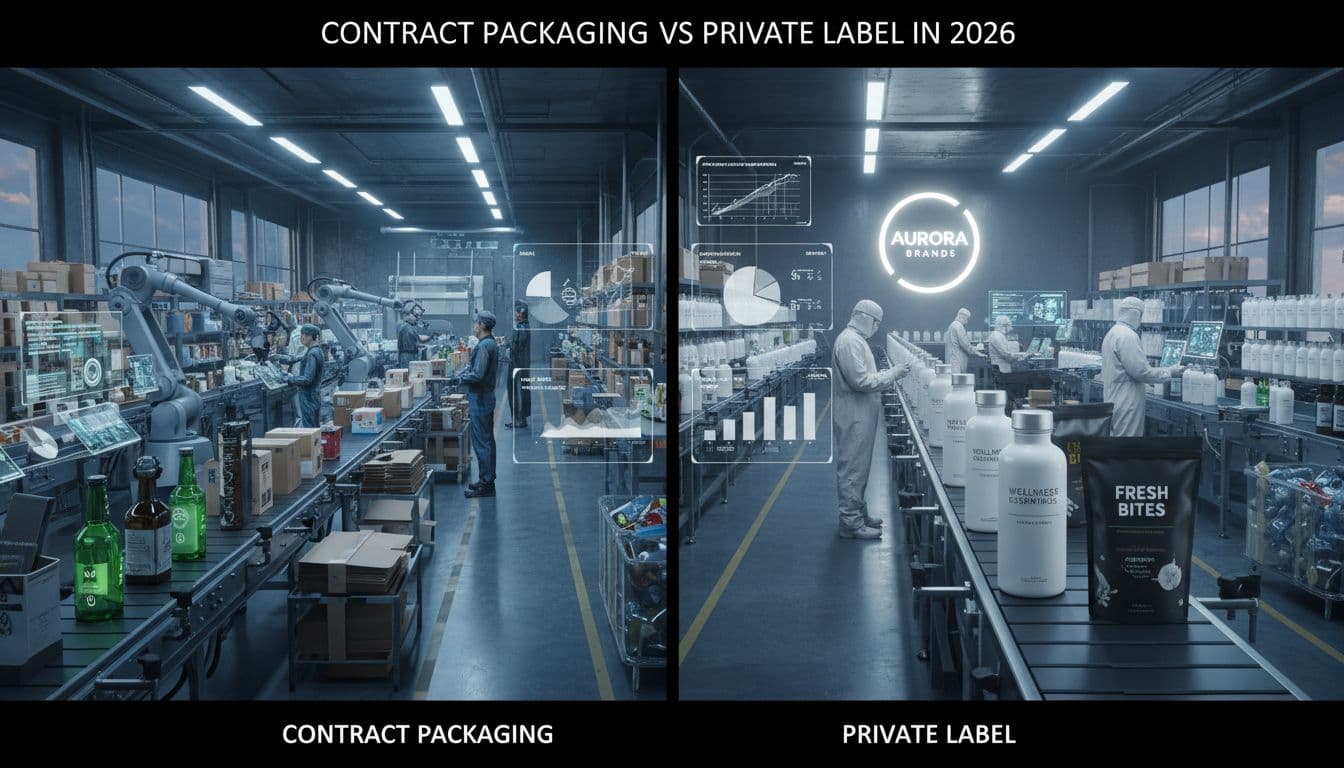
Contract Packaging Vs Private Label in 2026 (Speed, Control, Cost)
You’ve got a product idea, a target customer, and a rough plan, now you need it made and packed fast enough to sell, without burning your budget.
In simple terms, contract packaging (also called co-packing) means you supply the product (or source it), and a partner handles the packaging work, like filling, labeling, bundling, kitting, and getting it retail-ready. Private label means you put your brand on a product made by someone else, usually from their existing formulas, then you focus on positioning, design, and sales.
So, Contract Packaging Vs Private Label isn’t about which model is “better” in a vacuum. In 2026, the better choice is the one that fits your timeline, cash flow, and how different you need your product to be.
Contract packaging often wins when speed matters, volumes change fast, or you want to stay flexible. Private label often wins when you want a quick path to a sellable product, with lower product development lift, but you may face more look-alike competition.
This post breaks down the real trade-offs, speed vs control, cost vs uniqueness, and what matters most in 2026 (faster launches, tighter budgets, more competition, and higher quality expectations). By the end, you’ll know which path fits your business.
What Contract Packaging and Private Label Really Mean (and why people mix them up)

People mix these up because both options can get you a finished, shelf-ready item with your branding on it. The big difference is who owns the product itself, not just the packaging. If you remember one thing for Contract Packaging Vs Private Label, it’s this: contract packaging is built around your product plan, private label is built around their ready-made product.
Contract packaging (co-packing): you bring the product plan, they make and pack it
Contract packaging (often called co-packing) is closer to hiring an expert kitchen to cook your recipe at scale. In most cases, you own the formula, specifications, and quality targets, and the partner runs the production and packaging lines to match them. Some brands supply ingredients or components, others have the co-packer source them, but the end goal is the same: it’s your product, made and packed by a specialist.
Common steps in a co-packing workflow often include:
- Sourcing support: ingredients, packaging components, corrugate, labels (based on your approved specs)
- Batching and production: mixing, cooking, blending, or otherwise producing to your formula
- Filling: getting the product into bottles, jars, pouches, tubes, or trays
- Sealing and coding: lot codes, date codes, tamper-evidence
- Labeling: applying labels, sleeves, or printed packaging
- Kitting and bundling: multi-packs, gift sets, subscription boxes, promo bundles
- Case packing and palletizing: retail and warehouse-ready shipping units
- Shipping support: staging, routing, and sometimes fulfillment handoff
This fits best if you want a product that is truly yours, especially when your differentiation lives in ingredients, performance, or strict specs. If you’re weighing partner capabilities, a dedicated page like Full‑Service Contract Packaging can help you picture what’s typically handled end-to-end.
Private label: you pick a ready-made product and put your brand on it
Private label is more like choosing a proven menu item and putting your restaurant name at the top. The manufacturer typically owns the base formula, has already validated how it runs in production, and may sell similar versions to other brands. Your job is to choose the product, then make it look and sound like it belongs in your brand.
What you can usually change:
- Label design (graphics, brand name, claims that are allowed)
- Some packaging choices (bottle color, cap type, label material, case count, sometimes scent or flavor variants)
- Pack formats (single unit vs multi-pack, depending on their line)
What you usually can’t change much:
- Core formula and performance
- Ingredient deck and key specs
- Manufacturing process constraints (what runs well on their equipment)
Private label is popular because it’s a fast path to a sellable product. You skip most product development work and focus on brand, pricing, and distribution.
Quick comparison: control, speed, ownership, and how unique your product will be
Here’s the skimmable version most people care about. In the final draft, a small table like this keeps the differences clear.
| Factor | Contract packaging (co-packing) | Private label |
|---|---|---|
| Control over ingredients/specs | High (you set the target) | Medium to low (you pick from options) |
| Time to market | Medium (more setup, approvals) | Fast (product already exists) |
| Exclusivity | Possible (depends on agreement) | Often limited |
| IP ownership | Typically yours (formula/specs) | Typically theirs (base formula) |
| How easy it is to copy | Harder if product is unique | Easier, look-alike risk is higher |
If you want a broader side-by-side view, Co‑Packing vs Private Label: Which Fits Your Brand expands on the trade-offs brands run into when they move from idea to shelf.
Contract Packaging Vs Private Label: The 2026 decision factors that matter most

In 2026, the hard part is not getting a product made. It’s getting the right product to market before the trend cools off, while still protecting quality, margin, and your brand’s identity. That’s why Contract Packaging Vs Private Label has become a real decision point, not just an ops detail.
Private label can get you to a sellable SKU quickly, but it can also box you into supplier limits and look-alike competition. Contract packaging often takes more setup, but it gives you more ways to control what customers experience (and what retailers expect).
Speed to market: when private label wins, and when it is a trap
Private label is often faster because the product is already made, tested, and running on someone’s line. In the best case, you choose a base product, submit artwork, and you’re off to the races.
Private label is a strong choice when:
- You’re chasing a fast trend cycle and need something on shelf quickly.
- You don’t need unique performance to win.
- Your main advantage is distribution, content, or a strong audience.
But speed can fall apart when the “simple” steps pile up. Common slowdowns include label approvals, packaging lead times (bottles, caps, cartons), minimum order quantities (MOQs) that force bigger buys than you want, and supplier queues when their bigger customers jump the line. Even a quick product can get stuck waiting on the one missing component.
A simple rule of thumb: if you need to validate demand fast, private label can be the quickest test. Think of it like renting a car before you buy one. You learn what customers actually want, then decide whether it’s worth building something more custom later.
Product control and quality: when contract packaging is worth the extra work
Contract packaging is usually worth it when your brand promise depends on what’s inside the package, not just the logo on the outside. More control lets you shape the product experience, and that often means fewer complaints, fewer returns, and fewer “this wasn’t what I expected” reviews.
With contract packaging, you can often control things like:
- Ingredients and materials: what goes in, what doesn’t.
- Pack formats: bottle vs pouch, single vs multi-pack, bundle layouts.
- Shelf life and consistency: how the product holds up over time.
- Performance: how it tastes, smells, feels, or works.
- Compliance fit: labels, codes, and pack requirements for your channels.
That extra control matters more in 2026 because customer expectations are high and switching costs are low. One bad batch can spread fast through reviews and returns. When you can set tighter specs and check the work, you protect the brand you’re paying to build.
Keep it simple though: more control also means more responsibility. You may need to approve packaging, confirm specs, and make decisions when a material goes on backorder. If you want a practical checklist of what to lock down with a packaging partner, key components of a contract packaging agreement is a solid reference.
Brand protection and differentiation: standing out in a crowded 2026 market
Crowded categories create a pricing problem. If your product looks like ten others, you end up competing on discounts. Differentiation is how you keep margin and build loyalty.
Contract packaging often gives you more ways to build a product that feels like it could only come from your brand. That can be a unique formula, a unique pack format, or a unique unboxing experience. When customers can tell the difference, you have more pricing power.
Private label can still work here, but there’s a real risk: similar products show up with different labels. If a shopper compares ingredient lists or performance and sees they’re basically the same, your brand has to fight harder to justify the price.
Differentiation does not have to be complicated. Strong options include:
- Scent or flavor: a signature profile people remember.
- Texture or feel: thicker, lighter, gritty, smooth, fizzy, creamy.
- Pack size strategy: trial sizes, travel sizes, family sizes, club packs.
- Sustainability features: refill packs, less plastic, easy-to-recycle materials.
- Bundles: starter kits, routines, seasonal sets, subscription-friendly packs.
- Instructions or inserts: clear how-to cards, routines, FAQs, warnings, QR codes.
If your product needs hands-on kitting, inserts, or multi-SKU bundles to stand out, contract packaging can support those details through add-on services such as kitting services.
Costs and margins: upfront costs vs long-term profit
Most brands don’t fail because the idea is bad. They fail because the math doesn’t work once you add everything up. The key is separating startup costs from ongoing costs, then asking how fast you expect to scale.
Here are the cost buckets to compare:
- Setup costs: R&D (if needed), testing, tooling, and artwork.
- Unit cost: what each finished unit costs to make and pack.
- MOQs: how much cash gets tied up in the first run.
- Storage: where inventory sits, how long, and at what rate.
- Shipping: inbound materials, outbound finished goods, and extra handling.
- Chargebacks and returns risk: label mistakes, damage, missed retail specs.
The usual pattern looks like this:
- Private label tends to have lower startup cost because you skip most development. But the per-unit cost can be higher, and you may have less room to negotiate as you grow.
- Contract packaging often costs more to start because you’re setting specs, packaging, and processes. But once volume grows, the per-unit cost can drop, and you have more options to improve efficiency.
A good way to decide is to picture two futures. If you expect small, steady volume and want quick proof, private label can keep risk low. If you expect growth, channel expansion, and tighter retailer demands, contract packaging can pay off because it supports a product and package you can improve over time.
Which option fits your business model in 2026? Use these common scenarios

When you compare Contract Packaging Vs Private Label, the “right” answer usually shows up once you’re honest about your business model. Are you trying to prove demand fast, or are you trying to protect a unique product experience? Are you buying speed today, or building margin and control for next year?
Use the scenarios below like a mirror. If one sounds like your current reality, it’s a strong signal you’re choosing the right path for 2026.
Choose private label if you are validating a new idea or expanding a product line fast
Private label is a great fit when you want momentum. Think of it like using a pre-built house plan. You can move in fast, decorate it your way, and start living there, but you won’t change the foundation without major limits.
Private label is usually your best bet if these signals match you:
- You have a limited budget and don’t want to fund product development upfront.
- You need to launch in weeks, not months, because timing matters more than perfect differentiation.
- Demand is uncertain, and you’d rather test with a smaller bet first.
- Your strength is marketing and distribution, not product R&D or operations.
- You’re willing to compete on brand, content, placement, pricing, and speed, even if similar products exist.
A common scenario: you run a strong eCommerce brand, you see a trend popping, and you want a “good” product live fast so your funnel has something to sell. Private label can let you focus on what you do best, positioning and getting attention, while the supplier handles the product base.
Before you commit, answer these quick questions:
- MOQ reality check: Can you afford the minimum order quantity without stranding cash in inventory?
- Exit plan: If the product misses, how easy is it to stop ordering without fees or penalties?
- Supplier switch risk: Can you move to a new supplier without changing the whole product or packaging?
- Look-alike exposure: What happens if the supplier sells the same (or very similar) product to competitors?
- Brand moat: If the formula isn’t unique, what is your unfair advantage (audience, retail access, bundles, content machine)?
Choose contract packaging if you need a unique product, better margins later, or tighter quality control
Contract packaging makes sense when your product has to be yours in a real way. This is where Contract Packaging Vs Private Label flips, you trade some early simplicity for long-term control.
Contract packaging is usually the better fit if you relate to these signals:
- You have a proprietary recipe or clear spec that drives repeat purchases.
- You want exclusivity, or at least you want to reduce direct look-alike risk.
- You plan to scale, and you want a process you can improve over time.
- Packaging performance matters, like leak resistance, dosing accuracy, shelf life, or retail-ready formats.
- You have compliance requirements, such as strict labeling, lot coding, traceability, or retailer packaging rules.
A common scenario: you’re in a crowded category, and you know a “me too” product will force you into discounts. You’d rather build a product experience customers can feel, and pay for.
If you’re not sure what falls under contract packaging, an overview like different contract packaging service types can help you map your needs to real production and packaging steps.
Checklist before you move forward:
- Formula ownership: Who owns the formula, spec, and improvements? Get it in writing.
- Quality specs: Do you have measurable targets (weight, fill, seal strength, viscosity, tolerances) and an acceptance process?
- Ramp plan: How will you move from pilot runs to full production without surprises?
- Demand spike plan: If sales double next month, what’s the backup plan (extra shifts, secondary lines, safety stock, alternate components)?
A smart hybrid approach: start private label, then move to contract packaging when you prove demand
A hybrid approach is often the most practical play in 2026. Start with private label to test the market, then graduate to contract packaging once you’ve earned the right to invest.
Here’s how it works in real life:
- Launch a private label version to validate price, positioning, and channels.
- Listen hard to customers, reviews, returns, and support tickets (they tell you what to fix).
- Lock in the winner and build a custom spec that solves the real complaints or gaps.
- Move to contract packaging so you can control the formula, packaging, and quality as volume grows.
The timing signal to switch is not “I feel confident.” It’s visible traction:
- Repeat purchases (not just first-time buyers)
- Stable sales for several reorder cycles
- Clear differentiation needs, like a performance improvement customers ask for, or packaging changes needed for retail or shipping
Risk management matters here. Don’t pay for a custom product until you can forecast volume with some confidence. A custom setup is a bigger commitment, and it works best when demand is real, not just hoped for.
If your hybrid plan includes bundles, multi-packs, or retail-ready kits, services like kitting services can help you scale that “test and learn” phase without building your own packing operation.
How to pick the right partner and avoid costly mistakes (contracts, compliance, and ops)

Whether you choose contract packaging or private label, your partner becomes an extension of your brand. If they miss a spec, ship late, or can’t trace a lot, you own the fallout. The smartest move in the Contract Packaging Vs Private Label decision is simple: do your due diligence before you sign, and get the important stuff in writing.
If you want a broader view of what to look for when evaluating co-packers, this step-by-step co-packer selection checklist is a helpful companion to the questions below.
Questions to ask any manufacturer or co-packer before you commit
Send these as-is in an email. Short questions get clear answers, or they expose vague partners fast.
- What is your minimum order quantity (MOQ) by SKU and by run?
- What is your standard lead time from PO to ship date (and what makes it longer)?
- What is your typical schedule window (how far out are you booked)?
- Do you charge line setup fees or changeover fees? If yes, how are they calculated?
- What are your pack-out rates and scrap assumptions (and who pays for scrap)?
- What quality checks happen in-line during production?
- What testing happens before release (micro, stability, weight checks, seal checks, torque, etc.)?
- Can you share a sample COA or quality release document you normally provide?
- How do you handle out-of-spec product during a run (hold, rework, reject)?
- How do you assign lot codes (format, location on pack, and when applied)?
- What is your traceability process (one step back, one step forward)?
- How long do you keep production records and lot history?
- Who sources packaging components (bottles, caps, labels, cartons), you or us?
- If you source, do you provide component specs and get our approval before ordering?
- What are the backup options if a component is delayed (alternate vendors or materials)?
- Do you hold safety stock for key components? If yes, how is it billed and stored?
- What is your plan if there’s a labor shortage, equipment downtime, or a missed delivery?
- How do you define a defect (critical, major, minor) and what is your acceptance standard?
- What is your claim process for defects (timeline, documentation, photos, samples)?
- If a recall happens, who leads the process, and what support do you provide (trace reports, customer lists, retrieval, rework)?
- What certifications or compliance programs do you follow that match our category (and can we audit or review documentation)?
Protect your brand: who owns the formula, the packaging files, and the data
Ownership sounds like a legal detail, but it directly affects your margins, your ability to switch suppliers, and how defensible your product is.
Here’s the plain-English difference:
- Contract packaging: you usually bring (or control) the formula, specs, and bill of materials. In most deals, you own the formula and specifications, but only if the agreement clearly says so. Without that language, the “who owns what” question can get messy later.
- Private label: the supplier often owns the base formula and process. You’re typically buying access to a ready-made product, plus the right to brand it. That can be a great speed play, but it can limit how unique you can be.
Three terms to get clear on before you commit:
- NDA (non-disclosure agreement): this should cover your formula, packaging specs, pricing, and any custom changes you fund. It’s basic protection, not a premium upgrade.
- Exclusivity: if you want it, define it. Exclusivity can mean channel-only (for Amazon), region-only, or full exclusivity. Each has a cost.
- “Same base product sold to others”: common in private label. It means another brand can sell a similar product with different branding, sometimes in the same category and price tier. That can pressure your pricing and make your positioning harder, because customers compare labels, claims, and reviews.
Also ask who owns and controls:
- Packaging artwork files (editable source files, dielines, and print-ready PDFs)
- Tooling and plates (if any)
- Test results and quality data (so you can spot trends and defend claims)
If it’s important, don’t leave it as a verbal promise. Put it in the contract, including what happens if you part ways.
Operational realities in 2026: lead times, supply chain risk, and sustainability expectations
In 2026, launches don’t fail because the idea is weak. They fail because one small part shows up late, or a last-minute swap breaks the spec.
The most common disruptors look boring on paper, but they bite hard:
- Packaging component delays: caps, pumps, label stock, cartons, corrugate, shrink film.
- Ingredient substitutions (or private label base formula tweaks): can change performance, scent, texture, or claims support.
- Freight changes: higher costs, longer transit, missed appointments, tighter receiving windows.
- Retailer or platform rules: labeling, lot coding placement, suffocation warnings, bundling rules, case pack requirements, test protocols.
Sustainability also shows up in real buying decisions now. Retail buyers and customers notice excess air, extra plastic, non-recyclable parts, and oversized secondary packaging. Even if sustainability isn’t your headline claim, wasteful packaging can hurt reviews and conversions.
Practical questions to ask your partner:
- What are your realistic timelines for first run (artwork approval to ship), not best-case?
- What alternate materials or vendors are already qualified if a component goes out of stock?
- Do you recommend safety stock, and where will it be held (and who insures it)?
- If we need to change a component, what triggers a re-test or re-approval?
- Can you support lower-waste options (right-sized cartons, lighter materials, fewer components) without driving defect rates up?
Treat ops like a flight plan. You can still hit your launch date, but only if your partner plans for bad weather.
Conclusion
Contract Packaging Vs Private Label comes down to what you need most in 2026: speed, control, cost, or uniqueness. Private label is usually the quickest route to a sellable SKU with lower startup risk, because you’re choosing from a product that already runs. Contract packaging tends to win when your brand needs tighter specs, stronger quality control, and a product experience that’s harder to copy.
A lot of brands land on a hybrid plan. Launch private label to test demand, pricing, and channels, then switch to contract packaging once reorders and reviews prove the product is worth building out. That path lets you move fast without locking yourself into a “me too” item forever.
If you’re tightening up partner due diligence, use the Comprehensive 2024 Co‑Packing Services Guide as a reference for what a capable co-packer can handle and what to ask early.
Next step: write down your top 3 goals (speed, uniqueness, margin, control). Then use the checklists in this post to shortlist partners and request quotes that match your plan. Thanks for reading, what matters more for your next launch, getting to market first or owning the product experience long-term?
