
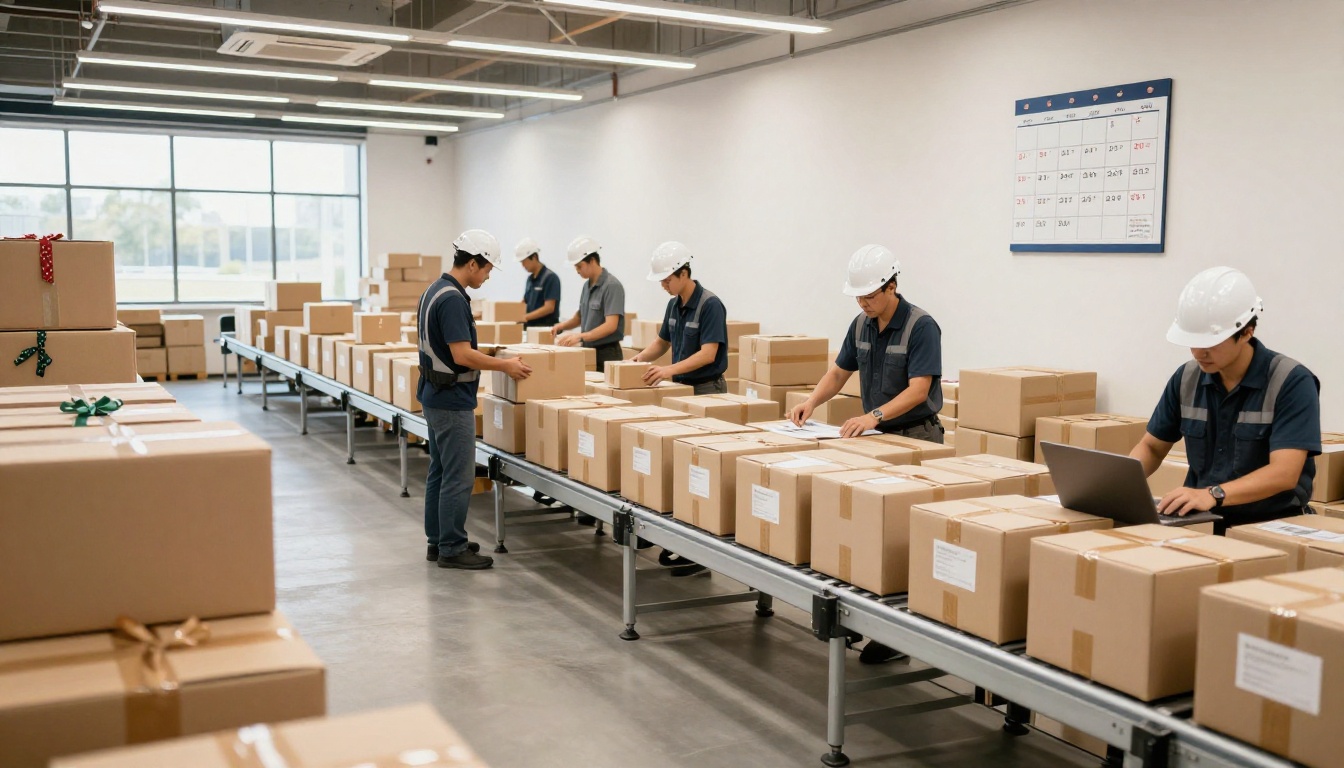
Seasonal Packaging: Scale Peak Demand Without Hiring More Staff
Peak season can sneak up fast. One week, orders look normal, then a promo hits, boxes run low, and your packing line slows to a crawl. Meanwhile, hiring temps sounds like the obvious fix, until you factor in recruiting, training time, mistakes, and the risk of not having enough hours to go around.
The good news is you can scale Seasonal Packaging demand without adding headcount. The goal stays simple: ship on time, protect product quality, and control costs, without burning out the team that already knows your process. That takes a plan you can repeat every year, not a scramble that starts when you’re already behind.
In this post, you’ll get a practical approach that combines better planning (starting earlier than you think), simpler packaging choices that reduce touches per order, and smarter workflows that keep pick, pack, and QA moving. You’ll also see when it makes sense to bring in outside support so spikes don’t turn into overtime marathons or late shipments, especially when you’re facing the impact of seasonality on e-commerce fulfillment and all the downstream pressure it creates.
If you’re tired of choosing between speed and quality every holiday rush, this is how to keep both.
Start with the bottleneck, measure where time and errors really happen

When Seasonal Packaging demand spikes, most teams react by moving faster. That usually backfires. Speed doesn’t come from pushing people harder, it comes from finding the constraint that sets the pace for everything else.
Start by mapping the path an order takes, end to end. Keep it simple: pick → pack → label → stage → carrier pickup. As you walk it, watch for where orders wait, where hands repeat work, and where errors slip in. Those spots are your bottlenecks, even if they look “normal” on a busy day.
To keep the effort practical, track only what helps you decide what to fix:
- Minutes per order (start pack to staged)
- Touches per order (how many times the order gets handled)
- Rework rate (anything that gets redone, re-packed, re-labeled)
- Damage rate (found before ship, and reported after delivery)
- Cutoff miss rate (orders packed but not on the truck)
Collect it fast using a one-week sample, simple tally sheets at the stations, plus scanner data and WMS reports when you have them.
If you can’t point to where time is lost and where defects start, you’re guessing. Peak season punishes guessing.
Do a one week time study that does not slow the line down
You don’t need a consultant and you don’t need to shadow every order. You need a small sample that reflects real work.
Use this mini plan:
- Pick your days: choose 2 to 3 typical days plus 1 busy day (promo, high inbound, or carrier crunch).
- Choose a sample size: track 25 to 50 orders per day, spread across SKUs and pack types.
- Time the flow: record pack start time, label printed time, and stage time. If you can’t time it, at least mark “waiting” vs “working.”
- Write down where they wait: note the exact spot, for example “packer waiting on dunnage refill” or “waiting for printer to reboot.”
- Capture the top 5 interruptions: keep a simple tally on a clipboard so you don’t rely on memory.
Common hidden drains to look for (they add up fast):
- Walking to find the right box size
- Searching for inserts, samples, or paperwork
- Printer jams or label roll swaps
- Unclear packing rules that trigger “ask a lead” delays
- Re-taping because the first seal failed or the box was overstuffed
Separate “slow because of people” from “slow because of the system”
Training issues look like hesitation, missed scans, or inconsistent packing. System issues look like good workers stuck waiting. Layout, missing supplies, unclear standards, and too many packaging choices are system problems.
Fix system issues first because they help everyone instantly, including your best people and your newest hires. This is the heart of lean logistics for supply chain optimization, remove waste so the work can flow.
A quick checklist for system fixes:
- Supplies at point of use: boxes, tape, dunnage, inserts, and labels within arm’s reach.
- Clear work steps: one-page packing standards with photos (what goes in, where it goes, and how it’s sealed).
- Fewer packaging options: reduce box, insert, and dunnage variations where possible.
- Fewer handoffs: avoid bouncing orders between stations unless there’s a real quality reason.
Pick the 3 metrics that predict seasonal chaos early

Four to six weeks before the rush, watch three leading indicators. They tell you what will break before it breaks:
- Packaging inventory cover (days on hand): Low cover means your team will start rationing, substituting, or stopping to “make it work.” That drives delays and damage.
- Average pack time per order: When this creeps up, it’s often because of extra touches, walking, or rework. It also signals that packaging variety has grown without control.
- Error and return drivers: Track the big buckets, wrong item, damage, and missing insert. Each one points to a different fix (pick checks, pack standards, or materials).
When these metrics shift, act immediately. It’s easier to fix a process on Tuesday in October than on the last shipping day before a holiday cutoff.
Forecast the surge and lock in packaging early, without overbuying
Peak season packaging problems usually start months earlier than they show up. A rush of orders feels like the problem, but the real issue is timing. Custom materials take longer, suppliers get booked, and shipping schedules tighten. The fix is not perfect prediction, it’s clear decision dates and a plan that keeps options open.
When you treat Seasonal Packaging like a rolling project (not a last-minute buy), you can secure the materials that matter most while avoiding the “pallets of leftovers” hangover in January.
Build a simple seasonal packaging calendar with lead times and decision dates

Start with four seasons and add two things: lead time and the date you must decide. Custom printed boxes and inserts often take longer than plain stock (customization can add weeks), so you want those decisions earlier than feels natural.
Here’s a simple, repeatable timeline you can copy into a shared doc:
- Winter (Jan to Mar): Lock in custom items with longer lead times. Confirm artwork, pack rules, and minimum order quantities. Then place orders for your highest-volume branded packaging.
- Spring: Sample and test pack-outs, then place summer buys. Use this window to validate sizing, damage rates, and pack speed before volume hits.
- Summer: Book storage space if you need it, and schedule staggered deliveries. Splitting deliveries protects cash and keeps you from sitting on a mountain of cartons.
- Fall: Switch more SKUs to simple generic packaging for speed. Save branded complexity for hero products, gift bundles, and top channels.
A calendar works because it forces choices early. You can adjust quantities later, but you can’t recover lost lead time.
Use sales signals to predict packaging needs sooner than your gut can
Your gut remembers the worst week from last year. Data remembers every week. To forecast packaging, build a simple weekly view and update it often. You can do this in a spreadsheet, and if you use an AI forecasting tool, think of it as software that spots patterns and sudden spikes faster than a person scanning rows.
A practical method:
- Pull last year’s weekly shipments by channel (DTC, Amazon, wholesale).
- Add known changes, for example a promo calendar, a new SKU, or retail expansion.
- Convert orders to packaging units (boxes, mailers, inserts) using your pack standard.
Then watch early signals that show up before orders do:
- Website traffic to top product pages
- Email and ad campaign dates and budgets
- Pre-orders, back-in-stock waitlists, and cart adds
- Wholesale POs and retailer forecasts (they often move first)
If week 38 looks like it’s tracking 15% above last year by early signals, don’t panic-buy. Instead, place a partial order now and schedule the rest as a decision gate in two weeks.
For a deeper view of forecasting approaches and partner support, see inventory forecasting with 3PL support.
Create a packaging safety stock rule that matches risk, not anxiety
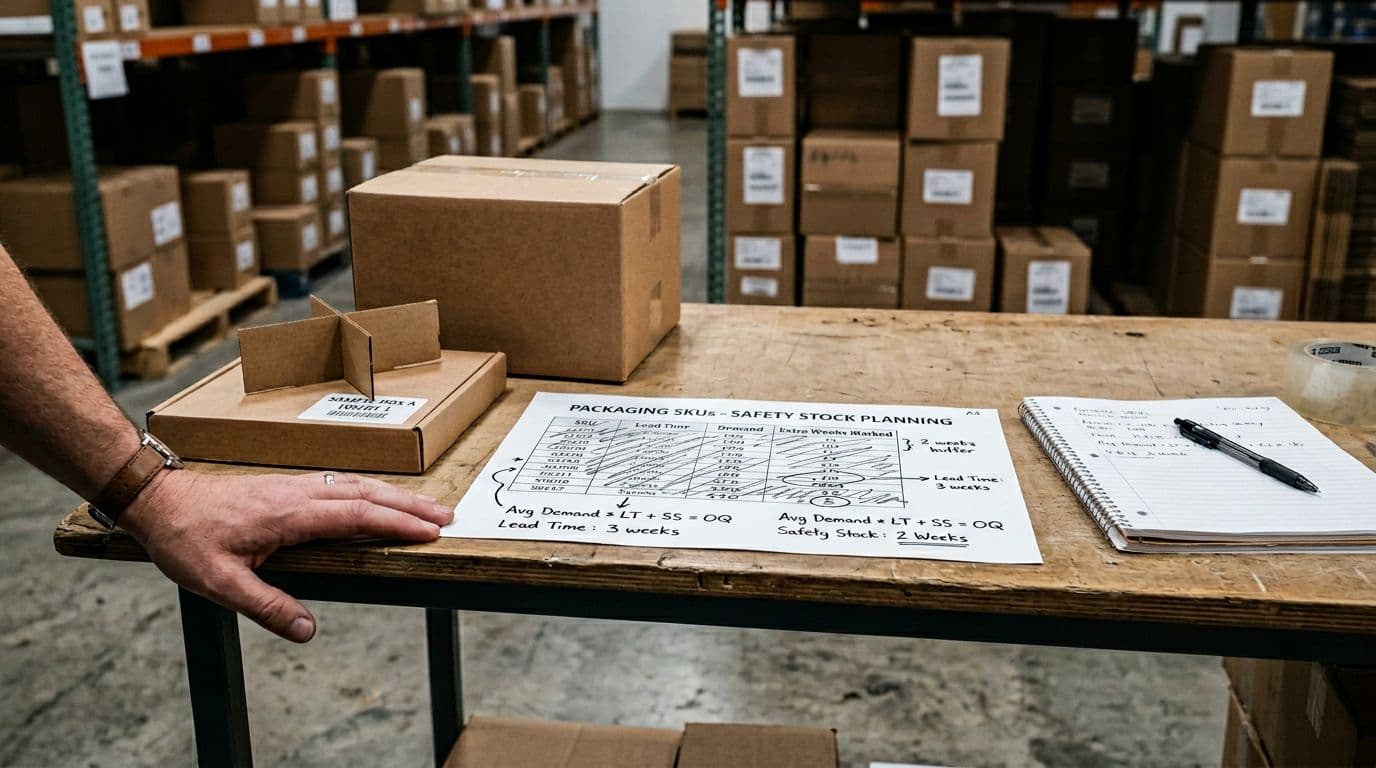
Safety stock should feel boring. If it feels emotional, it’s probably too high. A simple rule is enough: safety stock grows when lead time is long, demand swings are wild, or your supplier has inconsistent fills.
Use this concept:
- Safety stock = (average weekly usage × lead time risk buffer) × supplier reliability factor
You don’t need perfect math to act. Try an easy peak-season policy:
- Identify the top two box sizes that ship most orders.
- During peak, hold two extra weeks of each (above your normal reorder point).
- Keep little to no safety stock on packaging that has easy substitutes.
Example: If you use 500 of Box A per week and 300 of Box B per week, hold an extra 1,000 of A and 600 of B during peak. That buffer prevents a full stop when volume jumps or a truck shows up late.
To avoid cash traps, concentrate safety stock on the few SKUs that halt shipping when they run out (core cartons, labels, and void fill). Let the low-impact items stay lean, because extra tissue paper won’t save you if you’re out of boxes.
Make Seasonal Packaging faster by simplifying the packaging itself
When orders spike, every extra decision at the pack table costs you minutes. The fastest Seasonal Packaging setups feel almost boring because the work becomes repeatable. Fewer materials, fewer steps, and fewer “which box do I use?” moments add up to more packages out the door, without adding people.

Standardize box sizes and inserts so packing becomes muscle memory
Every box type is a fork in the road. If your team has to stop and compare sizes, pack speed drops and errors rise. With fewer box choices, pickers and packers move on autopilot, and new hires learn the routine faster because there are fewer “rules” to remember.
A simple approach is a core set of 3 to 5 box sizes that covers most orders, plus a small exception lane for odd shapes or high-value items. That core set should live within arm’s reach, not across the warehouse. In addition, consistent inserts (the same dunnage type, the same corner protectors, the same card placement) reduce guesswork. That consistency also protects product better, so you see fewer damages, fewer “arrived broken” messages, and fewer return labels.
Standard packaging is like a short menu. It speeds decisions, improves accuracy, and keeps quality steady under stress.
If you want more flexibility during surges, it can also help to consider short-term seasonal packaging benefits when volumes or pack-outs change quickly.
Use the sleeve or band approach for seasonal branding without seasonal boxes
Seasonal printed boxes look great, but they often create a planning trap. You commit to higher minimums, then guess the mix. If demand shifts, you end up with leftover cartons you can’t use later.
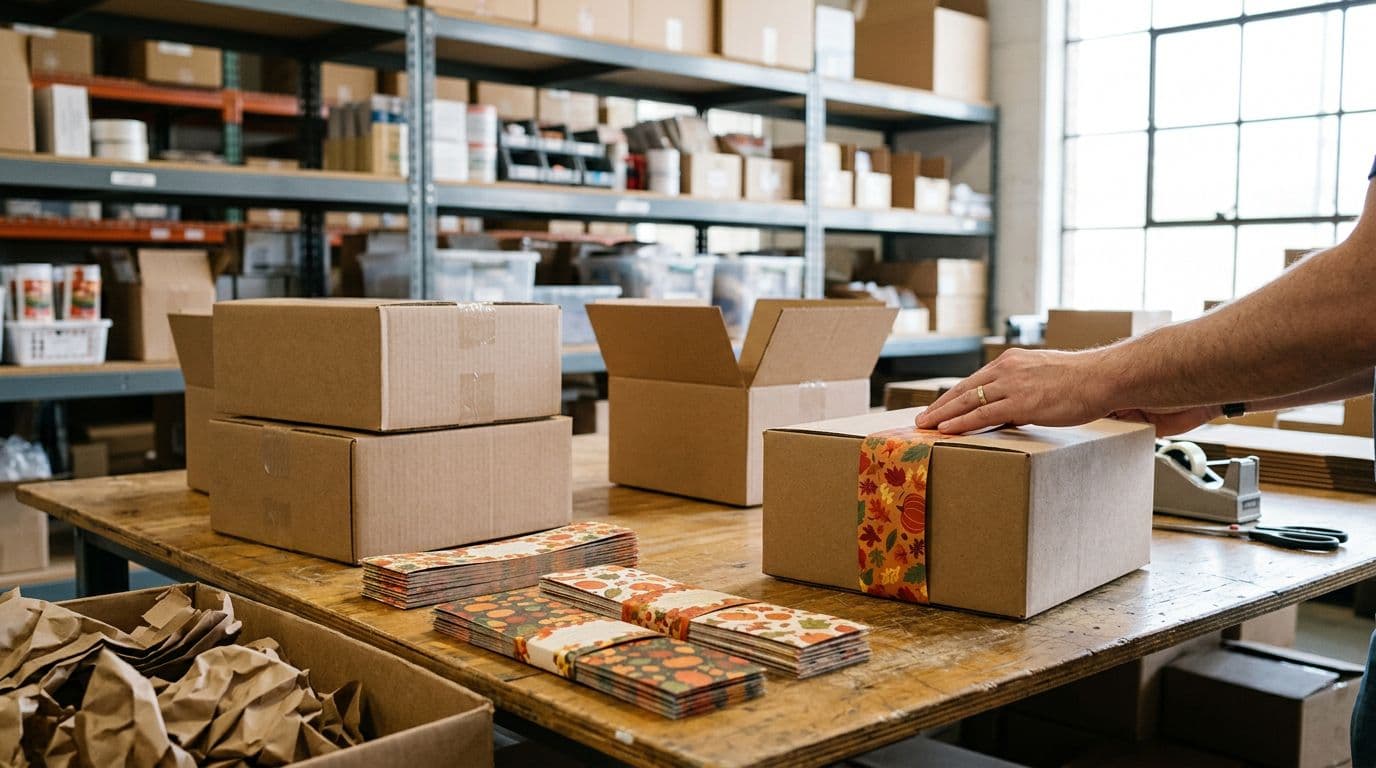
Instead, keep the same main carton year-round, then add seasonal branding as a top layer: a printed sleeve, belly band, sticker, or a themed insert card. Switching themes becomes a quick material swap at the station. It also keeps storage simpler because your core boxes stay the same, even when marketing wants a new look next week.
The tradeoff is per-unit cost. Sleeves or bands can add a few cents, but they often save more in avoided dead stock, fewer rush orders, and faster changeovers.
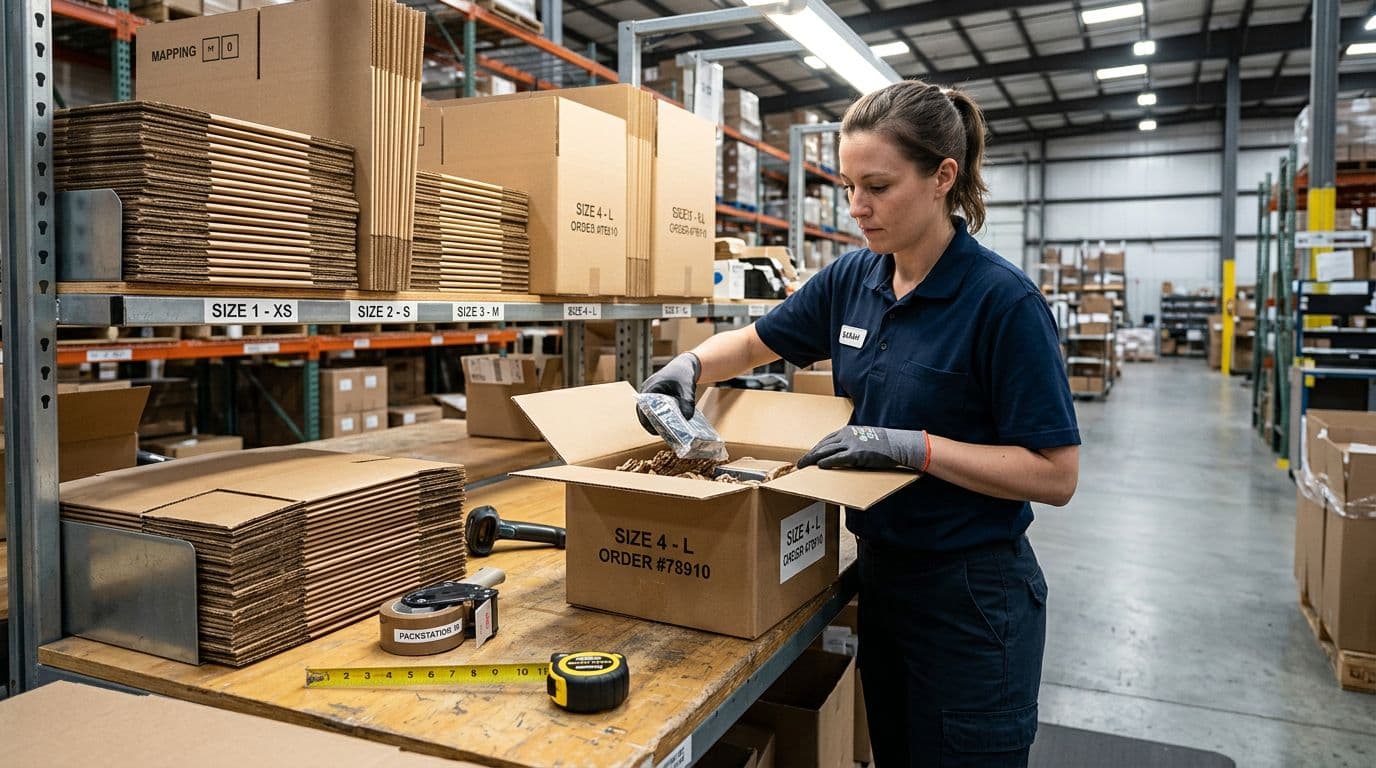
Right-size packaging to reduce void fill and packing steps
Oversized boxes create hidden work. They need more void fill, more tape, and more “press it down and hope” handling. On top of that, extra empty space increases damage risk in transit, which turns into re-shipments and support tickets.
Start with quick wins:
- Measure your top SKUs and top bundles (length, width, height, weight).
- Build a one-page pack guide that maps products to your core box sizes.
- Use pre-cut fill (or standard handful counts) so packers don’t wrestle with long paper runs.
Here’s a simple example mapping you can adapt:
| Product or order type | Box size | Insert standard |
|---|---|---|
| Single small item (cosmetics, accessories) | Small mailer/carton | 1 pre-cut paper pad |
| 2 to 3 items bundle | Medium carton | 2 pads, top-and-bottom |
| Larger kit or fragile item | Large carton | 4 pads plus corner protection |
Once the mapping is posted at the station, the job becomes repeatable. That’s how you cut labor minutes per order without cutting corners.
Increase throughput with better workflow, not longer shifts
Peak weeks in Seasonal Packaging expose every tiny delay, a missing roll of tape, a printer jam, a walk to grab dunnage. Instead of asking people to move faster (and make more mistakes), make the work easier to repeat. The goal is simple: fewer steps, fewer choices, and fewer trips per order.
Set up packing stations so everything is within one arm’s reach
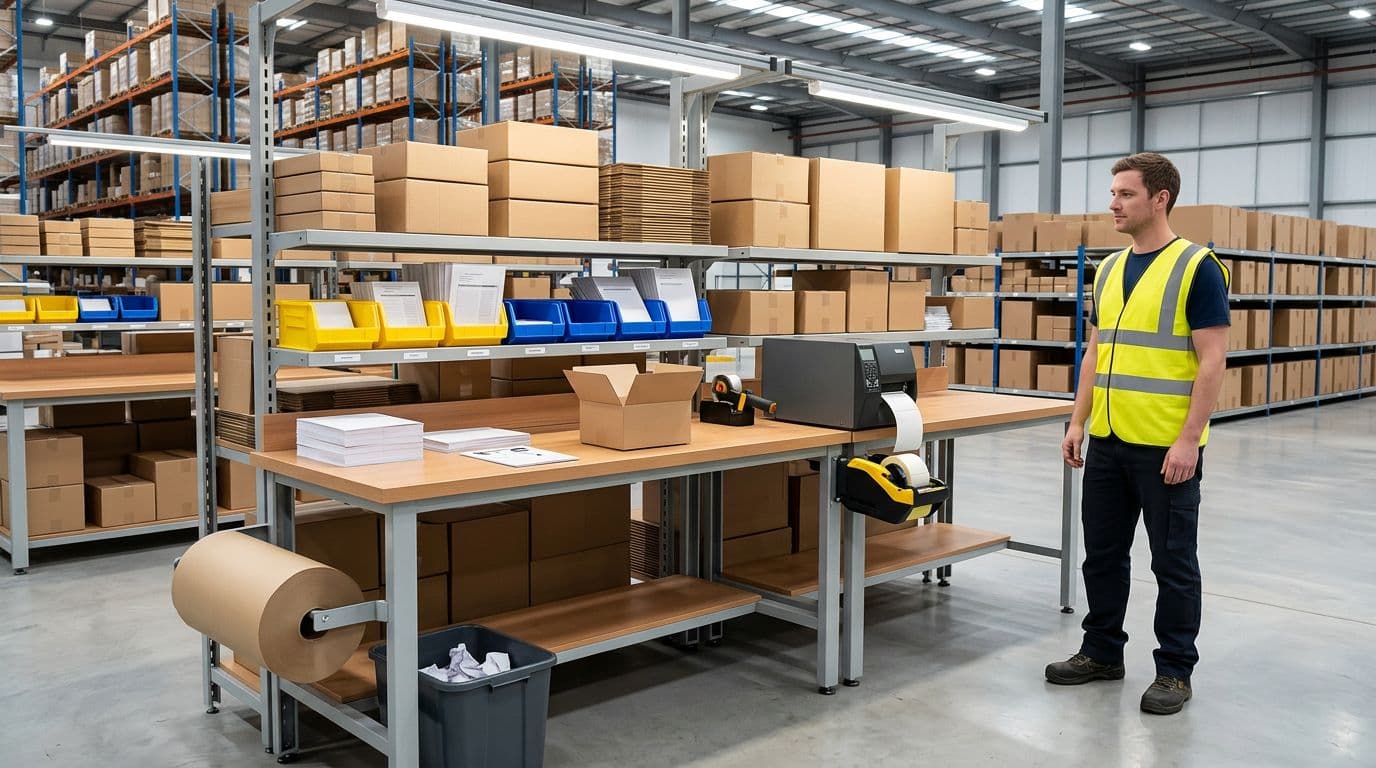
A strong station feels like cooking on a well-set prep line. Your hands stay in place, and the order flows through.
A basic layout that works for most small and mid-sized teams:
- Keep boxes above or beside the bench (small to large, left to right).
- Fix the tape dispenser and label printer to the same spot every time.
- Pre-stage inserts, samples, and documents in open bins at the front edge.
- Put dunnage and a waste bin within a half-step, not across the aisle.
- Reserve a clear “finished orders” spot so completed boxes don’t creep back into active work.
Use this quick supply checklist at shift start and after breaks: boxes, tape, labels, printer ribbon/toner (if needed), inserts, dunnage, spare blade, and a marker. Then add two-bin replenishment for high-use items (tape, labels, mailers). When Bin 1 empties, you switch to Bin 2 and trigger a refill, so you never run out mid-rush.
For more layout ideas, see optimizing warehouse layout for packing.
Batch work to cut walking and decision time
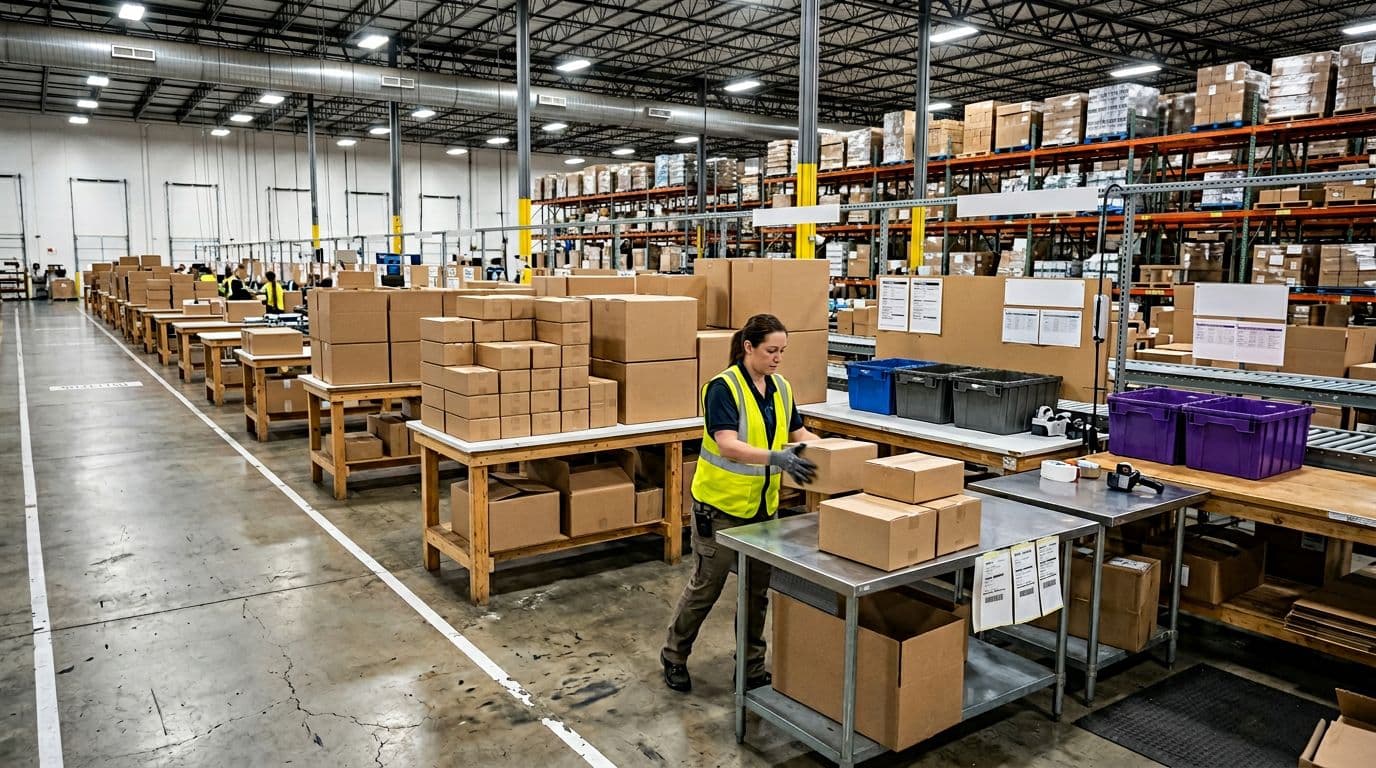
Batching means you handle similar orders together, like running a load of laundry by color. In practice, you can batch by box size, carrier, or order type (single-item, multi-item, fragile).
Batching helps most when:
- You have a few order patterns that make up most volume.
- Packers lose time choosing materials, searching, or switching steps.
However, batching can hurt when exceptions pile up (custom notes, mixed fragility, odd sizes). Too many special rules breaks the rhythm.
A simple peak rule: batch the top 2 to 3 order types, and keep one clear lane for oddballs. That lane protects speed for the main flow, without ignoring the weird orders.
Pre-kit the items and inserts that always ship together
Kitting is “do it once, use it many times.” Before the rush hits, build common bundles, or pre-stack what always goes in the box (thank-you cards, instructions, promo inserts, sample packs). At pack time, the worker grabs one kit, not five separate pieces.
You’ll see quick wins:
- Fewer touches per order because parts move as a unit.
- Fewer missing inserts because the kit is already complete.
Keep it controlled. Only kit what sells reliably, label kits clearly, and count them like inventory (a kit that “disappears” is still shrink). If you want a deeper kitting overview, reference kitting and packaging for e-commerce.
Add light automation where it pays back fast
You don’t need a full rebuild to boost throughput. Start with low-complexity upgrades that remove repetitive seconds from every box:
- Faster, more reliable label printers
- Scan-to-verify to catch wrong items before sealing
- Tape dispensers that cut clean and consistent
- Scale-integrated shipping so weights and labels match without re-typing
- A simple carton erector if you fold the same box all day
Estimate ROI with one easy math check: minutes saved per order × orders per day × peak days. If a tool saves 0.3 minutes per order and you ship 800 orders a day, that is 240 minutes saved daily, or four labor hours back without adding staff. For more ideas, review warehouse automation essentials.
Use flexible help without hiring, from co-packing to smarter supplier choices
When your Seasonal Packaging volume jumps, the real problem is usually capacity, not effort. If your line is already tight, adding temps can feel like pouring water into a leaky bucket. A better option is to add surge capacity through partners and supply decisions that reduce the number of things that can go wrong during peak.
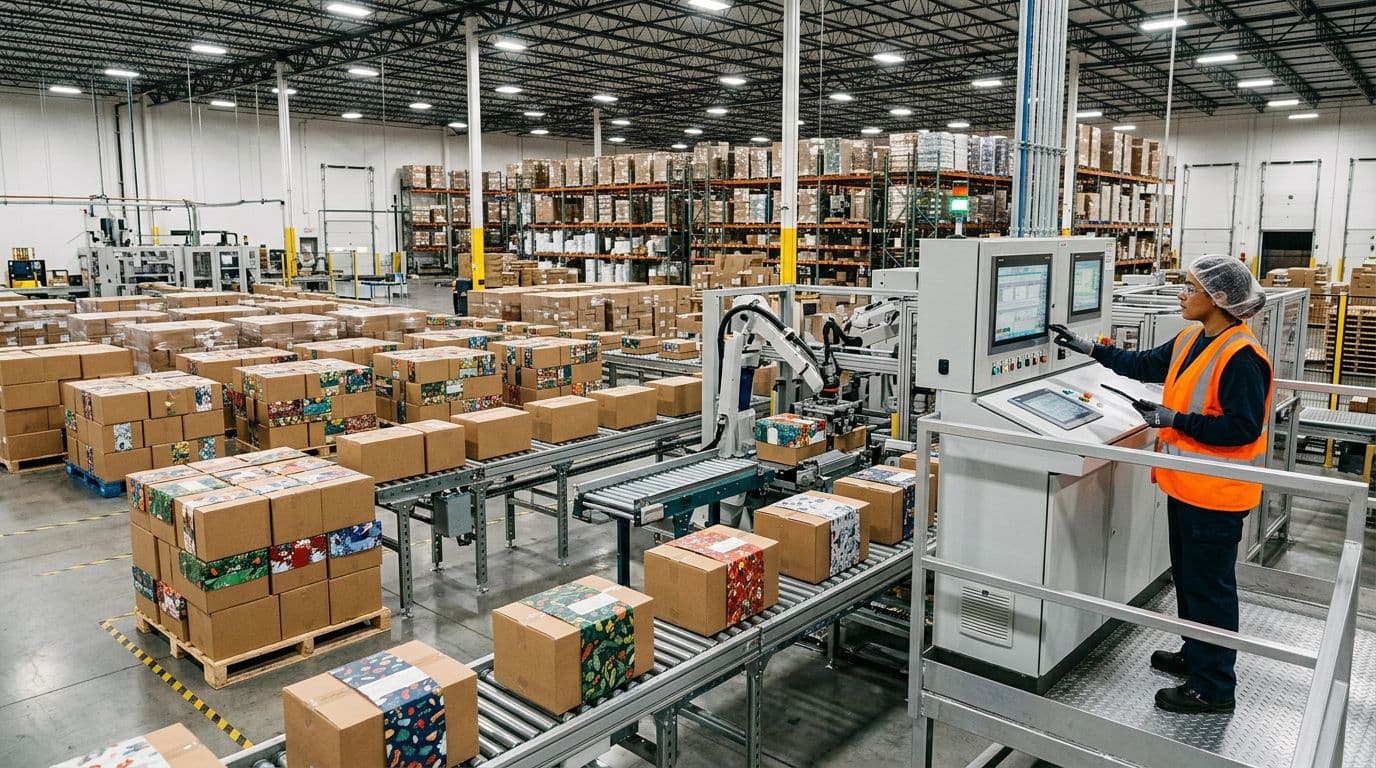
When a co-packer makes sense, and when it does not
A good co-packer is like an overflow lane on the highway. You use it when traffic spikes, so your core operation keeps moving.
Co-packing is usually a great fit for:
- Promo bundles and variety packs, where the work is repeatable and time-sensitive.
- Subscription boxes, especially when the contents are consistent week to week.
- Standard SKU packing, such as the same pack-out every time for a top seller.
- Large spikes, when you need extra hands for 4 to 10 weeks, not forever.
- Facility constraints, for example not enough benches, dock time, or storage to stage work.
On-demand co-packers can also scale with automated lines, so you pay for output (units packed) instead of carrying fixed labor. That can protect margins when demand swings.
It’s a poor fit when the job relies on judgment calls every order, or when risk is high without proven controls:
- Highly customized orders, like handwritten notes, frequent substitutions, or complex gift rules.
- Very fragile items if the partner has not proven the pack-out and drop-test results.
- Regulated products (or strict labeling and traceability needs) unless the co-packer already runs those processes daily.
If you want a reference point for what a capable partner typically covers, see these contract packaging services.
How to hand off packaging to a partner without losing quality control
The handoff is where most peak-season pain starts, not the packing itself. Treat it like giving someone your recipe, not just your ingredients.
Before anything ships to the partner, lock in a simple checklist:
- Approved packaging specs (box size, inserts, dunnage type, tape method, seal pattern).
- Pack-out photos for each order type, including a “finished and sealed” photo.
- Sample approval (golden sample kept on both sides).
- Barcodes and scan rules (what gets scanned, when, and what errors look like).
- Labeling rules (placement, orientation, lot codes, expiration rules if needed).
- QA sampling plan (for example, check 1 out of every X cartons, plus first article checks).
- Clear defect definitions (what counts as damage, wrong insert, wrong label, weak seal).
Run a small pilot before peak. You want to find the weird issues while you still have time to fix them. During peak, keep a tight communication rhythm: daily output counts, a shared issues log, and a fast “stop and confirm” rule when something looks off.
If quality standards live only in someone’s head, they won’t survive peak volume.
For a useful model of how packaging, checks, and fulfillment stages tie together, review the packaging and fulfillment process.
Reduce delays by simplifying your supplier base and shortening lead times
Peak season punishes complexity. Every extra vendor adds another shipment to track, another reorder point to miss, and another “it’ll be ready next week” surprise. Fewer vendors often means fewer handoffs, more consistent case packs, and clearer accountability.
Start by choosing a short list of trusted suppliers for core items (boxes, mailers, labels, dunnage). Then keep backup suppliers only for the critical items that can shut you down. Besides that, consider local or regional sources during peak. Shorter transit times make restocks feel like a refill, not a rescue mission.

One practical move that helps immediately is scheduled deliveries. Instead of taking 1 huge drop that clogs your aisles, split orders into timed arrivals (for example, weekly or biweekly). You keep cash freer, reduce storage overload, and still protect Seasonal Packaging continuity when demand surges.
Conclusion
Seasonal Packaging doesn’t have to mean panic, overtime, and rushed hires. When you measure the real bottleneck, you stop guessing and start fixing the one step that slows everything down. Then, when you forecast earlier and lock in packaging buys on clear decision dates, you avoid last-minute shortages and expensive rush orders. After that, simplifying box sizes, inserts, and seasonal branding keeps pack-outs repeatable, even when order volume jumps. Finally, a tighter floor setup and smart batching keep work moving, and flexible partners can absorb spikes when your own capacity is tapped out.
If you’re considering outside support, use when outsourcing packaging makes sense as a quick gut-check before peak hits.
This approach protects the team because it replaces hero mode with repeatable work.
3 actions to do this week:
- Time 30 real orders and write down the top 3 causes of waiting or rework.
- Pick your core 3 to 5 box sizes, post a one-page pack guide at the station, and remove extras from the immediate area.
- Set two calendar dates, one to confirm seasonal materials, one to confirm quantities (and line up a backup partner if volume keeps climbing).
