

Contract Packaging vs In-House Packaging: Costs, Scalability, and ROI Compared
Every growing brand hits the same fork in the road: keep packaging in-house, or hand it off to a contract packager. In plain terms, Contract Packaging vs In-House Packaging comes down to whether you own the people, space, and equipment, or you pay a partner to run the lines for you.
Companies wrestle with this because the trade-offs are real. Cash gets tied up in machines and floor space, speed can suffer when schedules get tight, quality can drift when teams are stretched, and headcount becomes a bigger problem than the packaging itself.
This comparison stays practical. You’ll get a clear cost breakdown (fixed vs variable), a scalability reality check for seasonal spikes and new SKUs, and a simple ROI framework to estimate payback and risk, before you commit.
The best choice depends on volume stability, product complexity, compliance needs, and how fast the business is changing. If you’re not sure when outsourcing starts to make sense, this guide on https://msl-indy.com/when-to-use-a-co-packer/ adds helpful context.
What you really pay for: upfront costs, ongoing costs, and the hidden line items
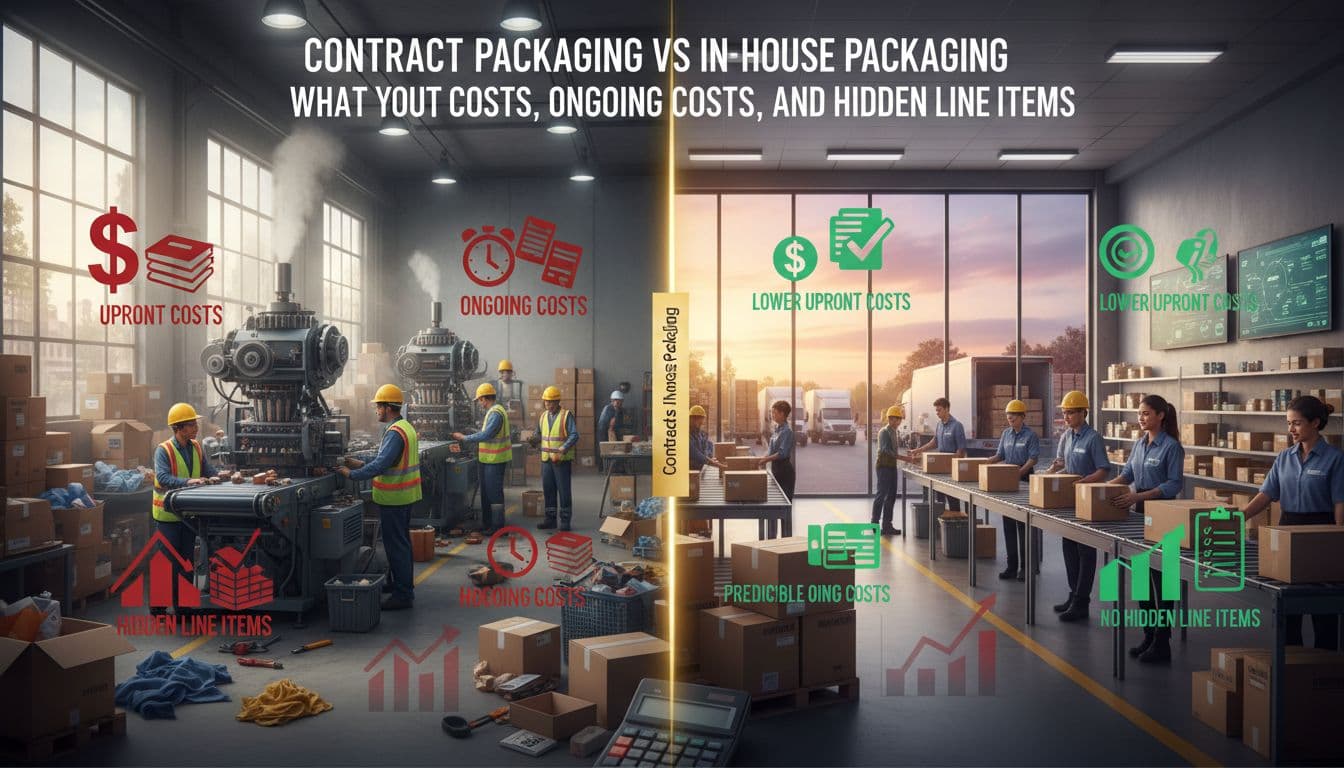
When people compare Contract Packaging vs In-House Packaging, “cheaper” can mean three different things. It might mean lower startup spend, a lower per-unit cost, or lower risk if demand changes. The right answer depends on how steady your volume is, how complex your packs are, and how much surprise you can absorb.
A simple way to think about it is rent vs buy. In-house looks like buying the house (big down payment, then you own it). Contract packaging looks like renting (smaller commitment, easier to scale up or down).
In-house packaging costs that show up on day one
In-house packaging gets expensive before the first finished case ships. Equipment is the obvious check you write, but it is rarely the only one. A basic line can require fillers, conveyors, labelers, sealers, scales, printers, and safety guarding, plus spare parts you cannot wait for when something breaks.
Facility needs hit fast too. Packaging takes floor space, staging space for components, and room for finished pallets. Then you pay ongoing bills like utilities (compressed air, power, HVAC), and those costs do not fall much when orders slow down.
People costs arrive early, even if you plan to “start small.” You still need:
- Training and onboarding so operators run safely and consistently.
- Safety programs (PPE, lockout-tagout, forklift training, incident reporting).
- Maintenance coverage (preventive maintenance, emergency repairs, calibration).
- Quality checks and documentation, especially if you sell into retail or regulated channels.
- Setup time to test runs, tune settings, and build standard work.
Many of these costs are fixed. If volume dips, the payroll, lease, and depreciation do not pause. Also, once you add a second shift, you usually add more than labor. You often need another supervisor, extra QA coverage, and more HR overhead for hiring, scheduling, and turnover.
Contract packaging costs that show up per project or per unit
Contract packaging shifts many of those fixed costs into a price you pay per unit or per project. Common pricing structures include per-unit rates, per-run or per-hour line time, and project fees for setup, changeovers, or special handling. Depending on the partner, you may also see add-ons for receiving, storage, pick/pack, and fulfillment.
This model often reduces capital spend because you are not buying the equipment, building the line layout, or staffing a full team. When your volumes and specs stay stable, outsourcing can also be predictable. You know the pack rate, you plan the runs, and you forecast the total.
Industry reporting often cites outsourcing as about 25% to 30% cheaper overall, on average, for many manufacturers, although results vary by product, speed requirements, and quality standards. The only fair way to compare is to look at your total landed cost, not just a headline rate. If you want a deeper view of line items that show up in quotes, this co-packing pricing breakdown lays out common charges in plain terms.
Hidden costs people forget to calculate in both options
In-house has quiet drains that do not show up in the budget. Downtime can wreck your true cost per unit because you still pay people while the line sits. Then there is scrap and rework, especially during learning curves, new hires, and changeovers. Over time, turnover becomes a real cost, because it forces retraining and often increases errors. Compliance mistakes also carry a price, from wrong labels to missed lot codes.
Contract packaging has its own “forgotten” costs. Shipping product and components to and from a partner adds freight and handling. Lead times matter too. If you miss a forecast, you might pay rush fees or change fees. Packaging updates can also take longer than expected, because artwork approvals, specs, and material lead times all stack up. Finally, someone on your team still owns vendor management, which means meetings, scorecards, and issue resolution.
Here is a quick example of how the math shifts. If you ship 10,000 units every month, in-house costs can spread out and start to look better over time, if your line runs smoothly. However, if you sell seasonally (10,000 units in peak months, 2,000 in slow months), in-house fixed costs keep running year-round. In that case, contract packaging can be cheaper because you pay less when volume drops, and you avoid paying for idle capacity.
Quick checklist: which cost profile matches your business today
Use these prompts to sanity-check which cost structure fits right now:
- If you have stable, high volume, in-house can win once the line stays utilized.
- If you need tight cash control, contract packaging usually lowers startup spend.
- If you have frequent SKU changes, outsourcing can reduce changeover pain, but watch change fees.
- If you have limited floor space, contract packaging avoids expanding your facility.
- If you need specialized packaging (kitting, bundling, complex labeling), a partner may already have the setup.
- If demand is seasonal or unpredictable, variable per-unit pricing often lowers risk.
Scalability and speed: how fast can you ramp up, add SKUs, or handle peak season

Speed and scale are where the “Contract Packaging vs In-House Packaging” decision gets real. It is not just about unit cost. It is about how quickly you can hire, train, qualify materials, and meet retailer or e-commerce packing rules when demand changes. A packaging plan that works at 5,000 units a month can crack at 50,000, especially when you add new SKUs or a major promotion.
The practical question is simple: when the forecast is wrong (because it often is), do you have a safe way to flex without breaking service levels or quality?
Why contract packaging can scale faster with less risk
Contract packagers scale fast because capacity is shared across multiple clients. You are not waiting to buy and install another line, or praying you can staff a second shift in time. Instead, you are tapping into existing space, trained crews, and flexible packaging lines that can be scheduled around your surge.
That flexibility matters most when you add SKUs. New flavors, new counts, seasonal bundles, club packs, and label changes all create changeovers. A partner that runs variety every day usually has changeover routines baked in, along with the tooling and line setups to switch faster.
Outsourcing also helps you access specialized methods without buying machines you might only need for one project. Think kitting, multi-packs, complex labeling, added QC steps, and even fulfillment handoff. For example, contract packaging services can cover kitting, labeling, QC, and fulfillment options in one place, which reduces the number of vendors you manage.
Here is a quick mini-story that shows why this can be safer. A beverage brand lands a late summer retail endcap for a 12-week run. The pack needs a new tray, a promo insert, and retailer-ready barcodes. In-house, they would need to source new materials, carve out line time, train temps, and still hit ship windows. With a contract partner, they can often slot the project into open capacity, test the pack, then ramp weekly volume as sell-through becomes clear. If the promo overperforms, you add runs. If it slows, you stop without owning idle equipment.
Where in-house packaging scales well, and where it hits a wall
In-house packaging can be quick when everything is already set up. If you have steady demand, a stable SKU mix, and trained operators on every shift, small tweaks can happen fast. You control the schedule, you can run a short batch, and you do not need to coordinate calendars with a partner.
The wall usually shows up when growth requires more of everything at once: space, staff, lines, supervisors, maintenance coverage, and quality oversight. That is not a simple “add one more person” problem.
Common bottlenecks include:
- Labor availability: Peak season often hits when warehouses and factories are all hiring.
- Training time: New hires need time to learn changeovers, inspections, and safe operation.
- Equipment lead times: Even if you have cash, machines, tooling, and parts can take months.
- Material qualification: New corrugate, labels, and films still need testing and approvals.
- Quality drift: Rapid growth can quietly increase rework, scrap, and customer complaints.
A second mini-story, this time where in-house can struggle: a skin care brand goes viral in October. Orders triple in two weeks, and they add two new gift sets. The team scrambles, pulls people from other work, rush-trains temps, and runs overtime. Boxes ship, but mislabels and missing inserts rise because the process changed faster than the training.
Quality, compliance, and consistency when volume changes
Scaling volume often increases errors because speed exposes weak steps. When the pace rises, it is easier to miss a lot code, grab the wrong label roll, or skip a check that was “obvious” at lower volume. The fix is boring but effective: locked-down processes, clear inspection points, and consistent documentation.
In-house has the advantage of direct control. You can walk the floor, adjust priorities, and hold daily huddles. Still, control only helps if the system can handle growth. If you are adding shifts, mixing new hires, and changing packs weekly, you need tighter SOPs than ever.
A strong outsourcing partner can help here because they often operate with established SOPs, QA routines, and structured handoffs that do not change when your volume swings. If you want to see what that kind of structure can look like end-to-end, this packaging and fulfillment process outlines a clear flow from receiving through packing and shipping.
The bottom line is that scaling should not mean gambling with quality. Whether you keep it in-house or outsource, the fastest path is the one that stays consistent when things get busy.
ROI explained: when each option pays off (and when it does not)

ROI is just a simple trade: the money and time you put in versus the value you get back. In the Contract Packaging vs In-House Packaging choice, value is not only a lower cost per unit. It is also fewer mistakes, faster launches, and less management time spent babysitting a line.
If you want a practical answer, focus on total monthly impact. You are trying to avoid two bad outcomes: building an expensive in-house setup that sits idle, or paying a per-unit outsource rate forever when your volume is high and steady.
A simple ROI framework you can use without a spreadsheet degree
Start with what you can measure in a normal week, then turn it into a monthly picture. Think of it like timing a commute. The route is not just miles, it is traffic, detours, and how often you get stuck.
Here is the basic flow:
- Estimate monthly volume. Use a realistic range (for example, 20,000 to 35,000 units), not a single perfect number.
- Estimate labor hours. Count direct hands on product plus setup and cleanup time.
- Estimate error rate and rework. Track wrong labels, missing inserts, damaged cartons, and recodes. Convert that into dollars (labor + materials + scrap).
- Spread equipment costs over time (for in-house). Take the total installed cost, divide it across its useful life, then add maintenance. If a line costs $300,000 and you plan to use it for 5 years, that is $60,000 per year before maintenance.
- Add the value of faster launches. Faster can mean you ship a week earlier, hit a retailer window, or avoid expedited freight. Those are real dollars.
Before you decide, gather these inputs:
- Average and peak monthly units
- Expected SKU count and how often you change packs
- Labor rate loaded with taxes and benefits
- Changeover time per run
- Rework rate and typical causes
- Floor space cost (rent, utilities, storage overflow)
- Equipment purchase and install estimates (plus lead time)
- The cost of missing a launch date (chargebacks, lost orders, lost shelf space)
Break-even thinking: the volume point where in-house can start to win
Break-even is the point where the total cost of both options is about the same. After that, the cheaper model starts to pull ahead. The key is fixed vs variable costs.
- In-house costs are heavy on fixed costs. You pay for equipment, space, and core staffing even when volume dips.
- Contract packaging is heavier on variable costs. You usually pay more per unit, but you avoid owning capacity you might not use.
This is why very high, steady volumes can favor in-house over time. If you run the same packaging format all year, your fixed costs spread across more units, and your cost per unit can fall.
Still, break-even is not just about unit count. Complexity moves the line. Kitting, multi-SKU variety packs, special labeling, retail ticketing, lot coding, or regulated checks can add labor, slow speed, and raise the true in-house cost. Meanwhile, a contract packager may already have trained teams and proven processes for that exact work, which changes the math.
The ROI you cannot ignore: speed to market and staying focused on your core work
Opportunity cost is a simple idea: if your team spends 15 hours a week running packaging, that is 15 hours not spent on sales calls, product improvements, retailer relationships, or customer issues. The cost does not show up on an invoice, but it shows up in results.
Speed matters because packaging often sits on the critical path. When it runs late:
- You can miss retail reset dates and lose placement.
- You can trigger stockouts that hand sales to a competitor.
- You may carry too much inventory to feel safe, which ties up cash and storage.
In Contract Packaging vs In-House Packaging decisions, this is where many brands feel the difference. If growth is the goal, your best ROI might be buying back leadership time and getting launches out on schedule, even if the per-unit price looks higher.
Common ROI traps that make teams choose the wrong option
A few predictable mistakes can push teams toward the wrong model, then lock them into it.
The most common traps look like this:
- Comparing only per-unit price: A lower unit rate can hide higher scrap, overtime, and supervision time.
- Ignoring downtime: When a machine stops, payroll keeps running. So does your ship date risk.
- Assuming perfect forecasts: If demand drops, in-house fixed costs hurt. If demand spikes, you may pay rush freight and overtime anyway.
- Forgetting quality failures: Wrong labels and missing components create returns, chargebacks, and customer support load.
- Underestimating hiring and training: Turnover is real. Training time and early-stage errors are part of the cost.
If you want a practical way to plan questions, scope, and true costs before you commit, use this contract packaging outsourcing guide to map what to ask and what to measure.
How to choose the best fit: a practical decision guide for your product and stage
The smartest way to decide between Contract Packaging vs In-House Packaging is to match your setup to how your business behaves today, not how you hope it behaves next year. Think of packaging like a kitchen. If you cook the same dish every day, buying equipment makes sense. If the menu changes weekly, renting a capable kitchen often wins.
Use the checkpoints below to turn a fuzzy debate into a clear next step.
Questions to ask before you decide (volume, variability, and complexity)
Before you price anything out, get honest answers to these questions. They tell you whether you need flexibility, control, or both.
- How steady is demand? Do you ship close to the same units each month, or do you swing hard with promos and seasonality?
- What does the SKU mix look like? How many SKUs run each month, and how many are “top sellers” vs slow movers?
- How often do specs change? Are labels, inserts, pack counts, or case packs changing quarterly, monthly, or weekly?
- How tight are quality requirements? Do you need lot traceability, photo checks, weight checks, seal checks, or retailer compliance steps?
- Do you need special packaging methods? For example, kitting, multi-packs, shrink wrap, blister packs, club packs, or complex labeling.
- How much space do you have? Include storage for components, WIP staging, and finished goods, not just the line footprint.
- What is your launch calendar? Are you planning new SKUs, gift sets, or retail resets that will compete for line time?
If your answers include high variability, frequent changes, or tight timelines, outsourcing tends to reduce schedule pressure. If your answers scream stable and repeatable, in-house or a hybrid model starts to look safer.
What to look for in a contract packaging partner
A good partner feels like an extension of your team, not a black box. Start with fit, then confirm they can execute under real conditions, like changeovers, rushes, and last-minute artwork updates.
Look for:
- Relevant product experience: Ask what they pack that is similar in size, fragility, and compliance needs.
- A clear QA approach: You want documented checks, defect handling, and traceability expectations from day one.
- Scaling capacity: How do they add shifts or line time when your forecast jumps?
- Communication habits: Who owns your account, how often do you meet, and how are issues escalated?
- Real lead times: Get clarity on scheduling, materials receiving cutoffs, and change request timelines.
- Cost transparency: Ask what triggers extra fees, like changeovers, rework, storage, or expedited runs.
- Support services: Kitting, labeling, display builds, and fulfillment can reduce vendor juggling. If you need a quick map of common options, review the types of contract packaging services.
A simple rule: if they cannot explain their process in plain language, problems will get harder when volume spikes.
If you keep packaging in-house: how to reduce risk and improve results
Keeping packaging internal can work well, but only if you treat it like a production system, not a side task. Small upgrades in discipline usually beat big promises.
Focus on:
- Standard work instructions: One-page steps with photos, torque settings, and “go, no-go” examples.
- Simple quality checks: Put checks at the point of failure (label match, lot code legibility, seal integrity).
- Preventive maintenance: Schedule quick weekly checks, plus a spare parts shelf for common failures.
- Cross-training: Train two people per critical role so vacations and turnover do not stop output.
- Capacity planning: Protect time for changeovers and launches, not just steady runs.
This approach cuts fire drills and keeps quality consistent, even when you add SKUs.
Real-world decision examples: which choice fits which situation
- Startup launching its first product: Demand is unknown, packaging may change fast, and cash is precious. Outsourcing often fits because it avoids locking into the wrong line too early.
- Seasonal brand with big spikes: Holiday sets, summer promos, and retailer events create short bursts. Contract packaging often fits because you can ramp up, then ramp down without carrying idle capacity.
- Established manufacturer with steady high volume and strict control needs: If the SKU mix is stable and the process is tightly controlled, in-house can make sense, sometimes with a hybrid approach for promos, variety packs, or overflow.
Conclusion
Choosing Contract Packaging vs In-House Packaging is really a choice between control and flexibility. In-house packaging gives you hands-on scheduling, direct oversight, and tight process ownership, but it also locks you into fixed costs like equipment, space, maintenance, and year-round labor. Contract packaging flips that model, you trade some day-to-day control for variable, per-unit pricing that can scale up or down when promos, seasonality, or new SKUs hit.
Scalability is where ROI usually swings. If your volume is steady and your pack format rarely changes, in-house can pay off once utilization stays high. On the other hand, if demand jumps around, your SKU count keeps growing, or timelines stay tight, outsourcing can protect cash and reduce the cost of idle capacity. The most important word here is utilization, because it drives your true cost per unit.
Before you decide, gather a few numbers: your monthly volume range, SKU count, quality and traceability needs, and launch timelines. Then run the simple ROI framework from this post using real assumptions, not best-case forecasts. Next, either tighten internal discipline with clear SOPs and QC checks, or talk with a contract packaging team to scope the work and request a quote. For extra perspective, read 7 reasons contract packaging is better than doing it in-house.
