

Amazon FBA Prep for Subscription Boxes and Product Kits: A Practical Guide
A subscription box or product kit can reach an Amazon fulfillment center with every item inside, yet still fail because the box has the wrong label, a loose seal, missing components, or packaging that allows products to shift. When customers buy a set, Amazon must receive it as one sellable unit, with the contents secured, clearly marked, and ready to scan and ship without separation.
Amazon stopped offering FBA prep and item labeling services for US shipments on January 1, 2026. Sellers now need to complete required work before inventory arrives, including kit assembly, FNSKU labeling, set identification, polybag warnings, expiration-date checks, and carton preparation. A reliable prep partner can also add documented quality checks, inventory counts, and corrective work before a shipment leaves your facility. MSL’s Amazon FBA prep services support labeling, kitting, polybagging, and other shipment requirements.
This guide covers Amazon’s rules, practical kit assembly, expiration dates, quality control, cost considerations, and how to choose a prep partner that can handle recurring subscription-box volume.
Key Takeaways
- Amazon FBA prep now requires sellers to complete labeling, kitting, packaging, and shipment preparation before inventory arrives.
- Mark subscription boxes and product kits as a single set, then keep every scannable label visible after packing.
- Use compliant polybags, protective packaging, and readable expiration dates in Amazon’s required format when applicable.
- Confirm each kit contains the correct components through documented counts, scans, and quality checks.
- Subscription box kitting services can support recurring volume while reducing mispicks, missing inserts, and label errors.
What Amazon FBA Prep Means for Subscription Boxes and Product Kits
Amazon FBA prep is the work you complete before inventory reaches an Amazon fulfillment center. The goal is simple: each unit must arrive packaged, labeled, and ready for Amazon to receive, store, pick, and ship without extra assembly.
For subscription boxes and product kits, prep often involves more than applying a barcode. Your process may include:
- Receiving components and checking them against the purchase order.
- Counting each item against a bill of materials.
- Assembling the correct products, inserts, samples, or accessories.
- Sealing the finished unit so items cannot separate during handling.
- Applying the correct product label and preparing shipping cartons.
- Creating the inbound shipment and packing inventory according to Amazon’s requirements.
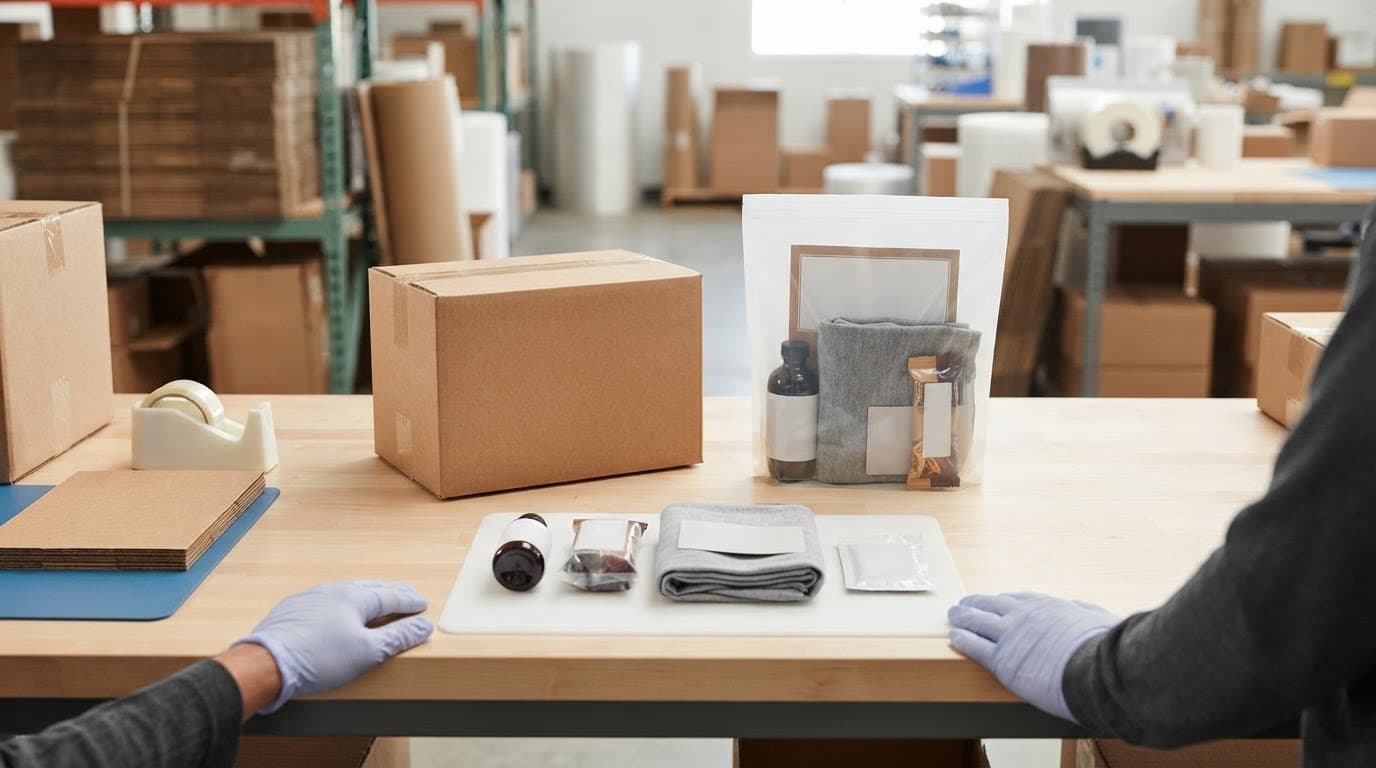
A set, a multi-pack, and a shared order are different
A true set contains multiple products that the customer buys and receives as one sellable unit. For example, a skincare routine with cleanser, toner, and moisturizer needs secure packaging and a label that identifies the complete set. Amazon’s guidance requires sets to remain together, so the package should indicate that it must not be separated.
A multi-pack usually contains multiple identical units, such as a two-pack of the same supplement. Manufacturer-created multi-packs may have their own product identifier. If you create the pack yourself, Amazon may require a separate listing and unique identifier for that pack.
Separate products placed in the same customer order are different. If a shopper buys shampoo, conditioner, and a brush as individual listings, Amazon can pick and ship each item separately. The products don’t become a kit simply because they share a shipping box.
Why variations need careful SKU control
Each assortment, size, color, quantity, or subscription tier may require its own product record. Amazon states that an FNSKU must correspond to one unique product, so a small kit and a large kit cannot share the same FNSKU. A blue version and a red version may also need separate identifiers.
A prep partner can assemble and verify these multi-SKU units using documented instructions. MSL’s contract kitting and packaging services can help convert separate components into correctly labeled kits before shipment. This is especially useful when subscription contents change by month, customer tier, or product variation.
Amazon FBA Prep for Subscription Boxes and Product Kits: A Step-by-Step Workflow
A reliable Amazon FBA prep workflow starts before components reach the packing table. Give your prep team a product brief, bill of materials, SKU map, packaging specifications, and approved sample. Together, these documents define exactly what the finished unit should contain and how it should look.
Build a Bill of Materials That Prevents Missing Items
The bill of materials (BOM) should list every component and required quantity, including inserts, samples, coupons, cables, accessories, and protective materials. Add the approved product version, SKU, lot or batch requirement, expiration rule, and packaging position for each item.
Similar-looking components need extra controls. Use clear SKU descriptions, photos, color identifiers, or scan validation so workers don’t confuse two sizes, flavors, shades, or cable types. If a product requires FIFO or FEFO rotation, record that requirement in the work instructions.
A visual pack-out guide should show the assembly sequence, component placement, orientation, and closure method. Include a photo of the approved finished kit at the station. That reference helps every shift follow the same process instead of relying on memory.

For example, a wellness subscription box might contain three products, a printed guide, and one promotional sample. The BOM should identify each item, its quantity, its position inside the box, and whether the sample belongs in every assortment or only one subscription tier.
Seal and Identify the Finished Kit as One Sellable Unit
After assembly, the box, bag, clamshell, or shrink-wrapped package must keep all components together during receiving, storage, picking, and shipping. Use fitted inserts, partitions, inner bags, adhesive closures, tamper-evident seals, or shrink film when needed. Loose components can separate, create count discrepancies, or arrive at Amazon as unidentified inventory.
The FNSKU for the complete kit belongs on the outside of the finished sellable unit. It must remain visible and scannable after packing. Barcodes on individual components identify those products separately, but they don’t replace the identifier for the physical kit.
The finished package should match the Amazon listing exactly, including the contents, variation, quantity, and external identifier. A virtual bundle is different because Amazon ships its component ASINs separately. A physical FBA kit must arrive as one packaged unit.
Use Final Inspections and Scan Verification Before Shipment
A final check should confirm the component count, SKU match, insert requirements, seal condition, barcode readability, and overall appearance. Scan verification at picking and packing helps prevent missing components and label swaps, especially when several kit versions share similar packaging.
Before dispatch, reconcile packed units with the shipment plan, apply carton labels correctly, and photograph representative finished units. Record defects such as wrong labels, missing inserts, damaged packaging, failed seals, or incorrect assortments. Keep nonconforming units on hold until an authorized person approves rework, relabeling, replacement, or release.
These records show where errors begin. Repeated shortages may point to receiving or picking, while label swaps may start during assembly. Run a small pilot first, review the results, then approve the larger shipment through Amazon FBA launch preparation.
Choose Packaging That Protects the Kit Without Raising FBA Fees
Packaging affects more than appearance. The right materials protect products, reduce storage space, limit shipping damage, and help prevent avoidable FBA costs. Use the lightest package that keeps the kit secure, then confirm the finished unit meets Amazon FBA packaging requirements.
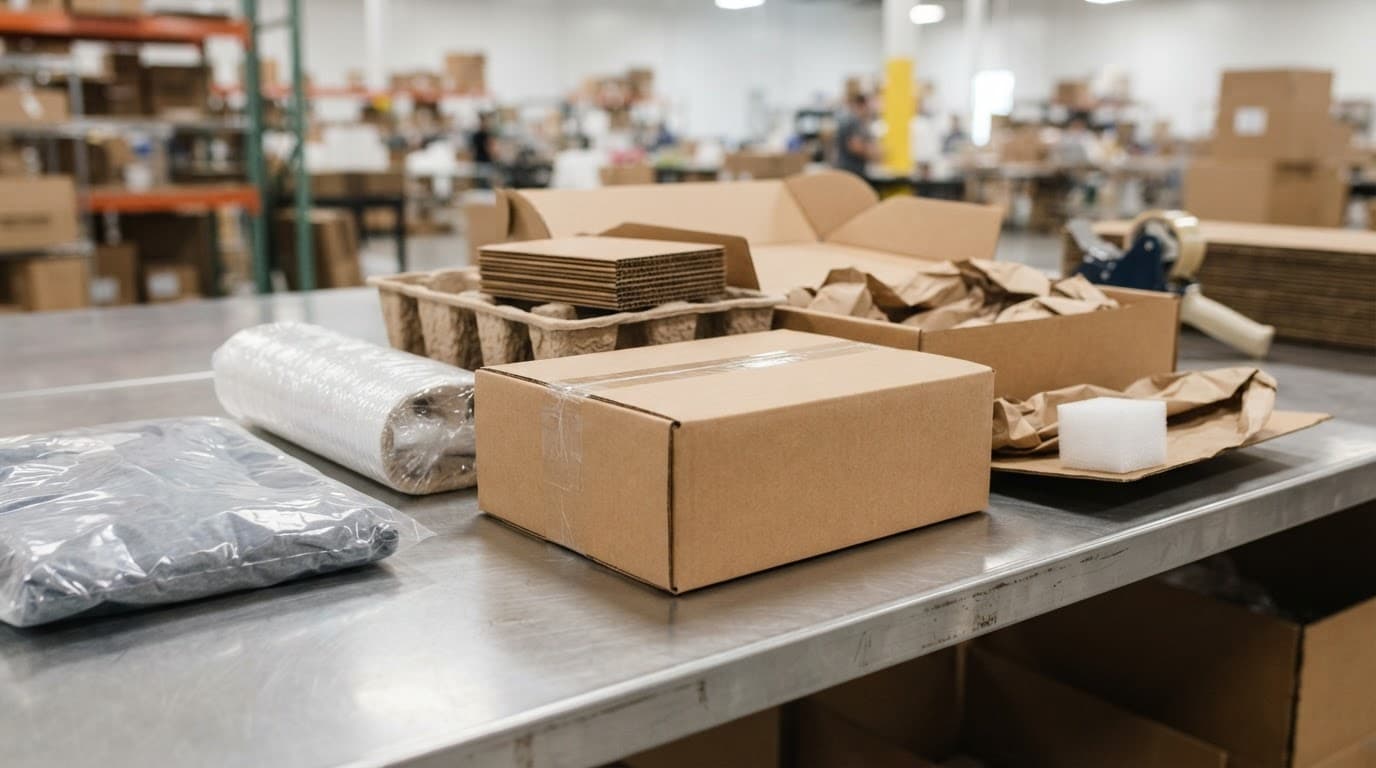
Use Poly Bags, Shrink Wrap, and Security Seals Correctly
A transparent poly bag or shrink wrap can hold a kit together while blocking dust, moisture, and casual tampering. These options work well for apparel, boxed samples, small accessories, and kits whose components already have enough structure. Clamshells and blister packs add visibility and stronger containment for small retail products, but they can add material cost and package volume.
Any poly bag with an opening of 5 inches or more when measured flat needs a suffocation warning printed on the bag or attached as a label. The required warning size depends on the bag’s combined length and width. Place it prominently on the outer bag, where customers and fulfillment staff can see it. A warning hidden on an inner product doesn’t meet the practical purpose of the rule.
Use durable seals when a kit contains loose pieces, liquids, food, or beauty products. The seal should resist normal handling without requiring excessive adhesive that leaves residue or damages the package.
Match Inserts and Cushioning to the Main Shipping Hazard
Start with the product’s most likely failure point. Partitions keep bottles, glass containers, and ceramic items from colliding. Die-cut inserts hold unusual shapes in fixed positions, while foam corners protect exposed impact points. Molded pulp or molded plastic inserts can provide a close fit for recurring kit designs.
Electronics may need anti-static bags or liners, especially when components can be damaged by electrostatic discharge. Moisture barriers help protect powders, food, paper goods, and beauty products from humidity or leaks.
Cushioning should stop movement without making the kit unnecessarily large. Paper void fill suits lighter items and fills small gaps, while foam or molded inserts provide more controlled protection for fragile products. An oversized carton needs more filler and may increase dimensional shipping costs. An undersized carton can crush products, break seals, or transfer impact directly to the contents.
Balance Shelf Appeal With Amazon Handling Requirements
A three-ply corrugated carton often fits lighter, durable kits. A five-ply carton provides better compression protection for heavy or fragile kits that may face stacking pressure. Rigid boxes improve shelf appeal, but the design still needs durable closures and enough internal support for warehouse handling and parcel shipping.
Keep branding readable and the unboxing experience polished, yet never cover the FNSKU, shipment labels, expiration details, or required warnings with decorative paper, stickers, or tissue. Before scaling a subscription box, test the finished package for drops, compression, scuffing, leakage, and component movement. A package that looks premium on a packing table must also arrive intact after real handling.
Get FNSKU Labels, Expiration Dates, and Product Information Right
Small labeling errors can delay receiving, strand inventory, or create customer complaints. Before every major launch, confirm the current requirements in Amazon Seller Central, then update your pack-out instructions and inspection checklist.
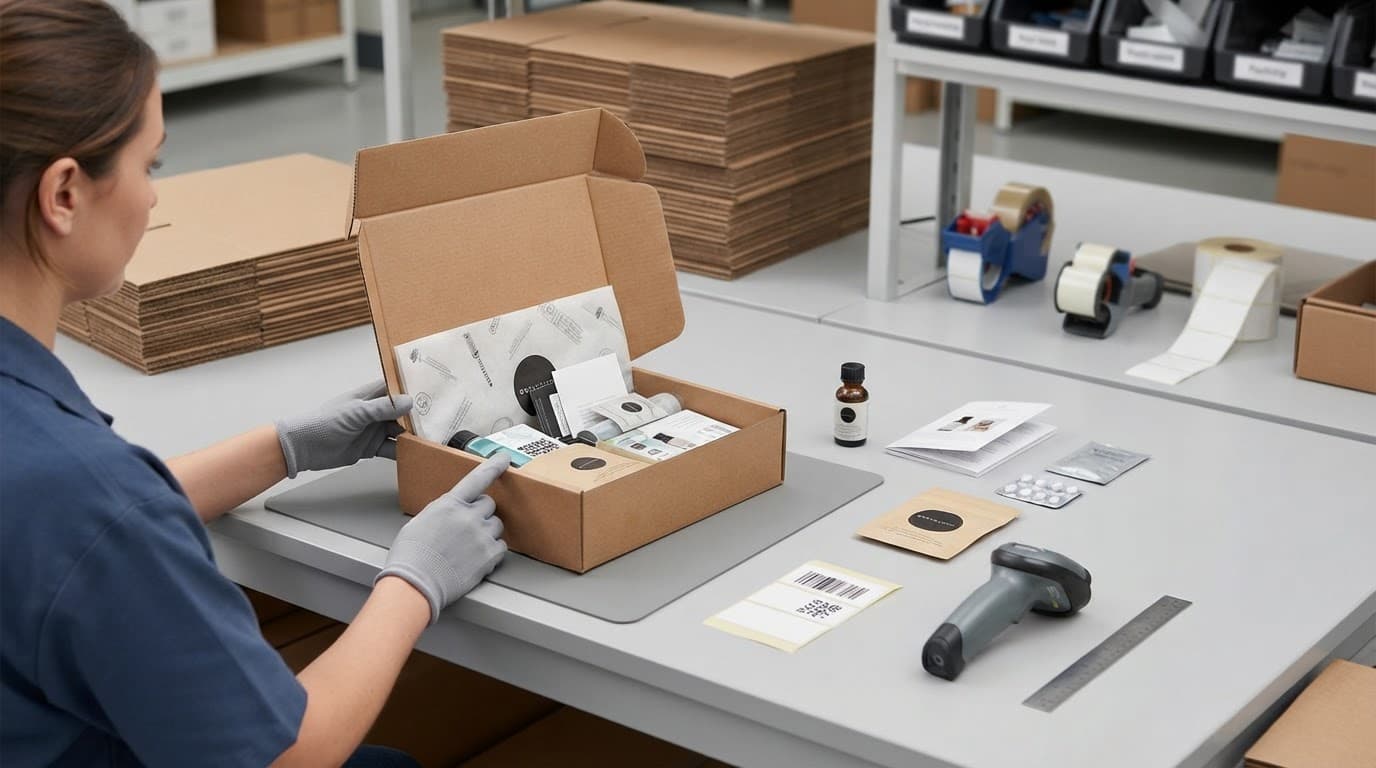
Give Each Kit Variation Its Own Product Identity
Each FNSKU must identify one unique product. A coffee subscription box with a dark roast is different from one with a medium roast. The same applies to beauty kits with different shades and children’s activity kits with different themes. Changing one core item can create a different sellable unit, even when the outer box looks nearly identical.
Maintain a master SKU and FNSKU chart that connects:
- The Amazon listing and ASIN.
- The kit version and variation.
- The complete component list.
- The finished-unit carton label.
Apply the correct FNSKU to the outside of the assembled kit, not to a loose component. Keep the barcode flat, unobstructed, and easy to scan. Use strong contrast, avoid curved or wrinkled surfaces, and don’t place tape, seams, folds, or decorative stickers across the code. A scan check at packing can catch label swaps before the shipment leaves.
For complex assortments, a contract packaging partner with quality control standards can support document control, label verification, count checks, and lot tracking.
Keep Dates Visible on Dated Subscription Products
For food, supplements, cosmetics, and other expiration-dated goods, use an accepted date format: MM-DD-YYYY or MM-YYYY. Lot numbers alone don’t replace an expiration date. Amazon requires the date on each individual unit and on the finished outer box or package. The outer date must use a font size of at least 36 points.
Date controls should begin during receiving. Record the lot and expiration date, then rotate inventory using first-expiring, first-out handling when appropriate. Set a rule for minimum remaining shelf life based on the product category, Amazon requirements, and any other sales channel requirements. Amazon guidance also requires enough remaining life for the product to be consumed, plus an additional 90 days.
If products arrive in mixed lots, keep each lot identifiable through assembly and storage. Questionable, unreadable, or short-dated inventory should remain on hold until an authorized person approves release, relabeling, rework, or disposal. After poly-bagging or bubble wrapping, the expiration date must still be visible on the outside.
Protect the Customer Experience With Accurate Inserts and Claims
Instruction cards, warranty details, usage directions, safety warnings, coupons, and promotional messages must match the current kit version. An outdated shade chart, incorrect usage instruction, or expired offer can create confusion and returns even when every physical product is correct.
Compare inserts with the Amazon listing and outer packaging before production. Product claims should remain consistent across all three. Also verify required warnings and safety information for the product category, without adding claims that the listing does not support. Clear document control keeps old inserts out of new kits and protects the customer experience after delivery.
What Does Amazon FBA Prep Cost for Kits and Subscription Boxes?
Amazon FBA prep costs depend on the work required to create one compliant, sellable kit. Receiving, storage, component picking, assembly, packaging, labeling, inspection, freight, carton handling, and shipment creation can all affect the final amount. In 2026, Amazon no longer provides US FBA prep and item labeling, so sellers must complete this work in-house or use a third-party provider.
Amazon’s published legacy examples provide a reference point, not a current quote. Standard-size units sold as sets showed $1.25 per unit for bagging and labeling, while the oversize example totaled $1.95. A third-party prep provider may charge less or more based on volume, materials, complexity, and service scope.
Compare Cost Per Kit With Total Fulfillment Cost
A low assembly rate isn’t always the cheapest option. If rushed work causes damaged products, chargebacks, extra storage, reshipping, returns, or inventory loss, the apparent savings disappear.
Compare in-house prep, a provider, and Amazon-related fees using the same total-cost formula. Include:
- Receiving, inspection, storage, and carton handling.
- Component picking, assembly labor, labeling, and shipment creation.
- Boxes, inserts, polybags, seals, labels, and packaging waste.
- Freight, accessorial charges, rework, returns, and disposal.
- Order changes, rush labor, seasonal capacity, and inventory discrepancies.
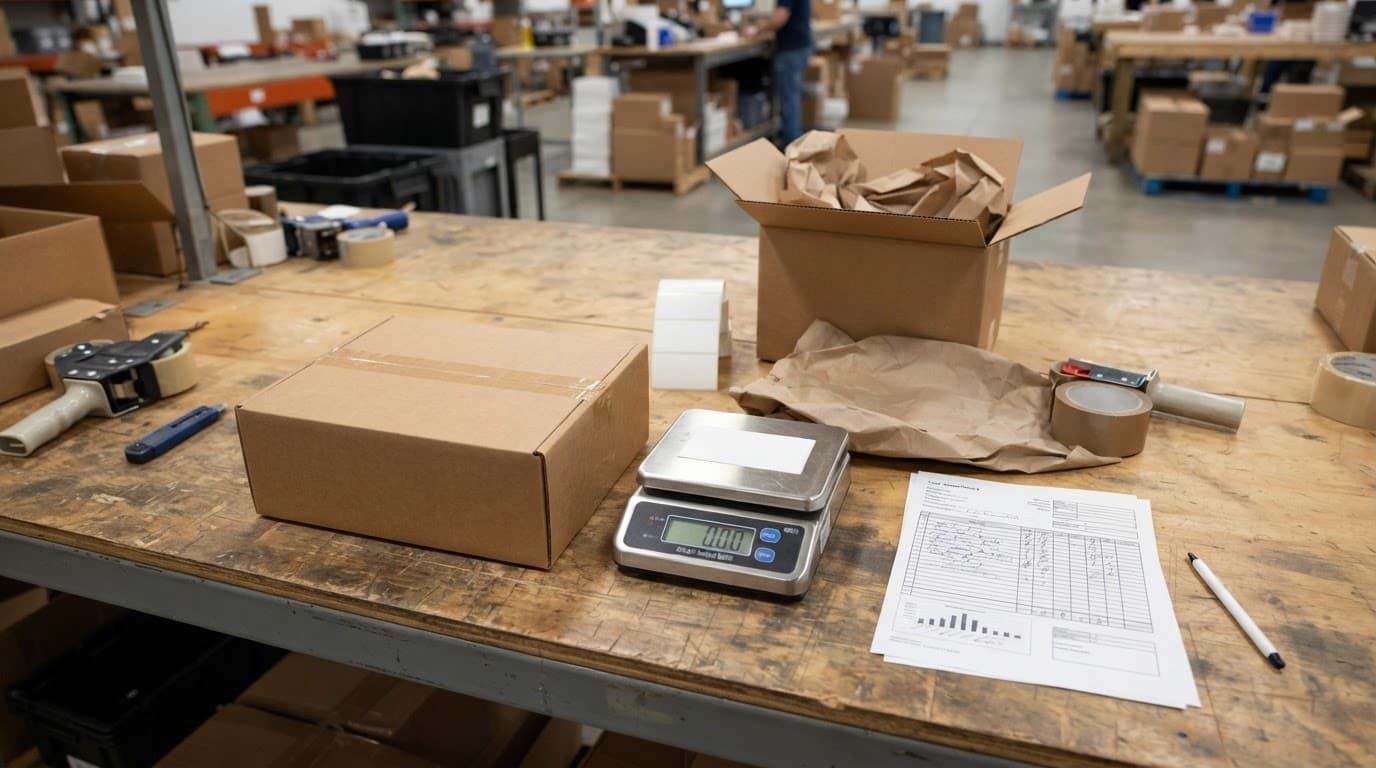
For example, fictional monthly assumptions might include $0.18 for receiving and storage, $0.72 for picking and assembly, $0.34 for materials, $0.12 for labeling and inspection, and $0.09 for freight handling. The resulting prep cost is $1.45 per sellable kit, before returns or rework.
Separate verified savings from harder-to-measure benefits. Fewer documented errors, lower material use, and reduced reshipping are measurable. Added capacity, lower operational risk, and less management time still matter, but track them separately instead of inflating the savings estimate. MSL’s Amazon FBA vs. contract packaging comparison can help frame that evaluation.
Ask for an Itemized Quote Before You Approve the Work
Request written answers to these questions:
- Are setup, receiving, inspection, storage, and minimum-order fees included?
- How are assembly, labeling, inserts, packaging materials, rework, and disposal billed?
- Are storage charges based on pallets, locations, cases, or actual occupied space?
- What costs apply to order changes, rush labor, seasonal volume, freight accessorials, and unused materials?
- Which charges are fixed, volume-based, or triggered by scope changes?
Also confirm who pays for failed samples, packaging redesign, replacement materials, inventory transfers, and temporary dual operations during the transition. A quote that clearly separates these costs gives you a more reliable total than a single attractive assembly rate.
How to Choose an Amazon FBA Prep Partner for Product Kits
The right Amazon FBA prep partner should handle more than assembly. Compare prep companies, 3PLs, and contract packaging providers by their controls, staffing, equipment, reporting, and ability to manage changing kit requirements. Experience with multi-SKU kitting, barcode scanning, dated products, fragile goods, retail packaging, and seasonal subscription volume matters because every added component creates another chance for an error.
Check the Provider’s Quality and Inventory Controls
Ask where scans happen, whether at picking, packing, or both, and how the team prevents label swaps. Confirm how often cycle counts occur, what inventory accuracy rate the provider tracks, and how staff investigate mismatches. Request sample reports showing mispicks, wrong labels, missing inserts, inbound damage, warehouse damage, and in-transit damage as separate categories.
Dated products may require lot or batch tracking, FIFO or FEFO rotation, and traceability reports. Also ask how the provider quarantines damaged or nonconforming products, who approves rework, restocking, relabeling, or disposal, and how held inventory stays out of production. Weekly summaries can reveal problems early, while monthly trend reports show whether corrective actions worked.

As a kit gains components, quality control must verify the relationship between every item, scan, label, and finished unit.
Confirm the Partner Can Handle Launches, Spikes, and Changes
Share your demand forecast, expected minimum and maximum volumes, subscription renewal cycles, seasonal promotions, and planned influencer launches. Ask about available floor space, equipment, backup labor, shift coverage, and capacity during peak periods. A provider that handles average volume well may struggle when a promotion doubles weekly output.
Find out how quickly the team can revise a bill of materials, replace an insert, update a label, or change a kit version. Written version control should prevent old and new materials from mixing. Before committing to a large shipment, run a pilot or small production batch and review accuracy, damage, turnaround time, and reporting.
Indianapolis-based MSL COPACK + ECOMM is one option to include when comparing contract packaging for ecommerce brands, especially for businesses that need kitting, labeling, fulfillment, and supply chain support in one operation.
Put Responsibilities and Service Levels in Writing
Your agreement should assign responsibility for inventory, packaging materials, artwork, Amazon account data, approvals, damaged goods, recalls, returns, rework, and freight. It should also explain who pays for replacement materials, disposal, corrective work, and carrier claims.
Set measurable service levels for:
- Order turnaround and shipment accuracy.
- Inventory accuracy and cycle-count frequency.
- Damage rates and barcode scan failures.
- Reporting deadlines and escalation contacts.
- Corrective action timing after a quality issue.
Request a sample workflow, service-level agreement, insurance details, facility capabilities, capacity plan, and client references. Written change procedures also define approval steps and pricing before a new insert, label, or kit version creates scope drift or surprise charges.
Common FBA Prep Mistakes That Hurt Kit Sellers
Small preparation errors can create large costs when Amazon receives a product kit. A missing component or hidden barcode may delay receiving, strand inventory, trigger rework, or send an incomplete order to a customer. Review these common failures before every shipment.
Sending Components as Loose Inventory
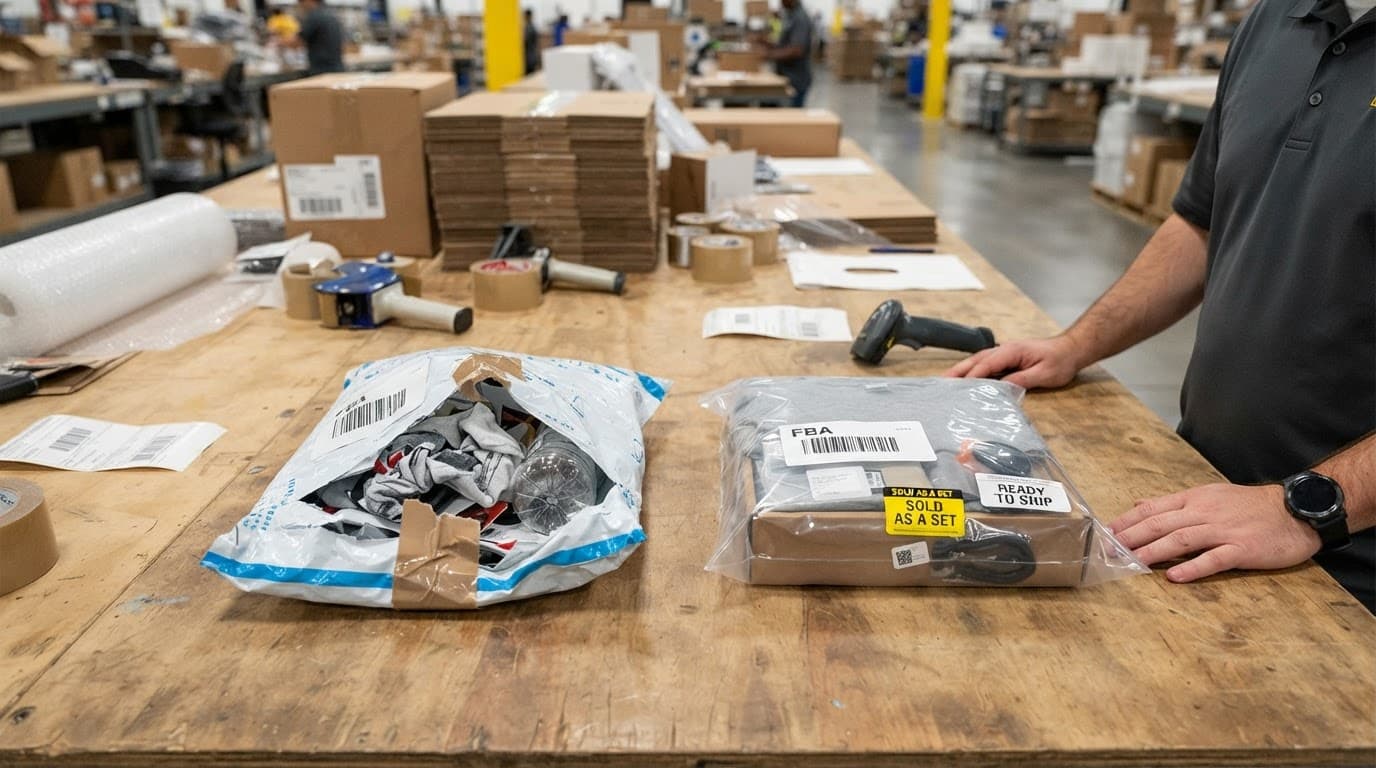
A kit must arrive as one sellable unit. Sending a box with loose bottles, samples, inserts, or accessories allows components to separate during handling. Amazon may receive the items incorrectly, and customers may receive incomplete kits.
Secure the contents in a sealed box, bag, shrink wrap, or other suitable packaging. Mark the package clearly as a set, using wording such as “Sold as set” or “This is a set. Do not separate.”
Using the Wrong FNSKU or Hiding It
One FNSKU cannot identify several assortments. A coffee box with dark roast products needs a different product identity from a box with medium roast products, even if the outer packaging looks similar.
Apply the correct FNSKU to the finished kit. Keep it flat, visible, and scannable without opening the package. If component barcodes remain visible, Amazon may scan the wrong item and treat the set as separate inventory. Cover internal barcodes when the outer kit barcode is the identifier Amazon should use.
Placing Warnings and Dates Where Nobody Can See Them
A suffocation warning hidden inside a polybag or package does not help the person handling the outer unit. Polybags with an opening of 5 inches or more need a warning printed on the bag or attached as a label. The bag must also close completely.
Expiration dates create another frequent failure. For dated products, show the date on each unit and on the outer package in a readable format. If the outer box hides the date, receiving delays, disposal, customer complaints, and returns can follow.
Skipping Counts, Lot Checks, and Version Control
Workers can pack the wrong shade, flavor, insert, or accessory when similar components share a station. Mixed lots can also create inconsistent shelf life across subscription shipments.
Use the BOM to count every component, then record the lot or expiration information when required. Keep outdated inserts and old packaging away from current materials. A missing-item complaint often leads to refunds, replacement shipments, and avoidable rework.
Overpacking or Shipping Before Approval
An oversized carton increases dimensional fees and may leave products moving inside the box. Untested packaging can split, crush, leak, or fail during carrier handling. Approve a sample after drop, compression, seal, and movement tests.
Finally, confirm the listing, ASIN, FNSKU, unit quantity, and shipment plan all match the physical kit. Shipping before those records are correct can strand inventory or cause receiving discrepancies.
Pre-Shipment Checklist
Before releasing cartons, confirm:
- The BOM matches the approved kit version.
- The FNSKU is correct, visible, and scannable.
- Component barcodes are covered when required.
- Seals, polybags, and warnings meet Amazon’s requirements.
- Expiration dates appear on units and outer packaging.
- Counts, lots, inserts, and carton contents are recorded.
- Shipment and carton labels match the shipment plan.
- The final sample has written approval.
Frequently Asked Questions
Amazon FBA prep for subscription boxes involves more than placing products in a carton. Sellers must control the finished unit, labeling, dates, sealing, and shipment timing before inventory reaches Amazon.
Can Amazon still prep and label my subscription boxes in the United States?
No. Amazon ended FBA prep and item-labeling services for US shipments created on or after January 1, 2026. Sellers must complete compliant preparation themselves or use a third-party provider before inventory arrives at the fulfillment center.
Amazon’s operational rules can change, so confirm the current policy and shipment requirements in Seller Central before each major launch.
Does every product inside a kit need its own FNSKU?
The finished kit needs the FNSKU connected to the sellable unit listed on Amazon. Individual components may also have labels, depending on how they are listed, commingled, or handled, but those labels don’t replace the identifier for the complete kit.
Check that the kit FNSKU matches the exact assortment, quantity, variation, and packaging configuration being sent to FBA. A different combination may require a separate product identity.
Can I send a subscription box to FBA without sealing it?
An unsealed box can allow products to shift, separate, or become damaged during receiving and transportation. Amazon may also treat loose components as separate items if the packaging doesn’t clearly keep the set together.
Use a secure seal, shrink wrap, fitted insert, adhesive closure, or another suitable method that preserves the retail presentation. The finished package should remain closed during normal handling without hiding its required barcode.
What happens if one item in a product kit has an expiration date?
Dated products require lot control and date checks during receiving, assembly, and final inspection. The expiration date may need to appear on each individual unit and on the outer kit package, where associates can see it.
Confirm the category-specific requirements in Seller Central. Before shipment, document lot numbers, expiration dates, remaining shelf life, and the approval of any mixed or short-dated inventory.
Is an FBA prep service worth it for a small subscription-box brand?
The answer depends on kit complexity, labor time, storage needs, error costs, and growth plans. A provider may make sense when assembly pulls your team away from sales or production, demand changes often, or one packing mistake costs more than the service fee.
Compare your internal labor and materials with ecommerce kitting and labeling services, including rework, storage, and shipment handling.
How early should I send materials to a prep partner?
Plan backward from Amazon’s shipment deadline and allow time for receiving, inspection, assembly, quality checks, corrections, and transportation. Add extra time for new packaging, artwork updates, seasonal surges, and the first production run.
A small pilot can expose missing materials or pack-out problems before the full order begins. Build approval time into the schedule so rushed corrections don’t create new labeling or assortment errors.
Conclusion
Successful Amazon FBA prep depends on treating every subscription box or product kit as one controlled, sellable unit. Define the bill of materials, assign the correct FNSKU, choose right-sized protective packaging, keep dates and warnings visible, and verify every finished kit before shipment.
The goal is more than passing Amazon receiving. Each customer should receive a complete, undamaged, easy-to-identify product that supports repeat purchases and a reliable subscription experience. Before the next launch, compare total in-house and outsourced costs, then review the workflow with a qualified subscription box fulfillment partner.
